

If you sell to other businesses rather than individual consumers, you’ve probably realized that the playbook used by consumer brands doesn’t translate well to your world. Buying decisions takes longer, more people are involved, budgets are scrutinized, and trust has to be earned over months, not minutes. This is exactly why a clear, well-thought-out B2B strategy matters so much.
A B2B strategy is the overarching plan a business uses to market and sell its products or services to other companies rather than individual consumers. It defines who you’re targeting, how you’ll reach them, what message will resonate, and how you’ll guide them from first contact to signed contract, and ideally, to long-term loyalty after that. Unlike a loose collection of marketing tactics, a true B2B strategy ties every activity back to specific business goals, whether that’s generating qualified leads, shortening sales cycles, or increasing average deal size.
In this guide, we’ll break down everything that makes up a strong B2B strategy: the B2B marketing process from start to finish, the most effective B2B marketing strategies being used today, the different types of B2B marketing you can choose from, proven B2B marketing best practices, and the B2B marketing trends shaping how companies sell to each other in 2026 and beyond.
What Is a B2B Strategy and Why Does It Matter?
At its core, a B2B strategy answers four fundamental questions: Who are we trying to reach? What problem are we solving for them? How will we reach and convince them? And how will we measure whether it’s working? Without clear answers to these questions, marketing efforts tend to become scattered: a bit of social media here, an occasional email blast there, a website that hasn’t been updated in years, all without building toward a larger goal.
A solid B2B strategy matters because business buying decisions are fundamentally different from consumer ones. B2B purchases typically involve multiple decision-makers, longer evaluation periods, larger financial commitments, and a much higher emphasis on logic, ROI, and risk reduction over emotional impulse. A buyer choosing a new software vendor or a manufacturing supplier needs to justify that decision to colleagues, finance teams, and sometimes entire committees. A well-built B2B strategy accounts for this complexity by creating content, messaging, and touchpoints that speak to every stakeholder involved in that decision, not just a single end user.
Companies with a defined B2B strategy also tend to allocate budget more efficiently. Instead of spreading resources thin across every possible channel, a strategic approach identifies where target buyers actually spend their time and concentrates on effort there. This focus is what separates businesses that generate consistent, predictable pipelines from those constantly scrambling for their next deal.
What Does the B2B Marketing Process Look Like?
Understanding the B2B marketing process is essential before diving into specific tactics, because it provides the framework that everything else fits into. While every company’s version looks slightly different, most effective B2B marketing processes follow a similar arc.
Step one: Market and audience research. This stage involves identifying your ideal customer profile (ICP), the type of company that gets the most value from what you sell and building buyer personas representing the different individuals involved in the purchase decision, such as economic buyers, technical evaluators, and end users.
Step two: Positioning and messaging. Once you understand who you’re targeting, the B2B marketing process moves into defining how you’ll differentiate from competitors and what core message will resonate with each persona. This stage often involves clarifying your value proposition in terms buyers actually care about, like cost savings, efficiency gains, or risk reduction.
Step three: Channel and content planning. Here, the B2B marketing process determines where and how you’ll reach your audience, whether that’s LinkedIn, email, search engines, industry events, or a combination, and what content you’ll need to support each stage of the buyer’s journey, from awareness to consideration to decision.
Step four: Lead generation and nurturing. This is where campaigns actually launch. Leads are captured through gated content, webinars, demos, or outbound outreach, then nurtured through email sequences, retargeting, and sales follow-up until they’re ready to engage with a sales conversation.
Step five: Sales handoff and alignment. A mature B2B marketing process includes clear criteria for when a lead is “sales-ready” and a smooth handoff process between marketing and sales teams, often supported by a shared CRM and lead scoring system.
Step six: Measurement and optimization. Finally, the B2B marketing process loops back on itself through ongoing analysis of what’s working: tracking metrics like cost per lead, conversion rates, and pipeline contribution, so that future campaigns improve based on real data rather than guesswork.
What Are the Most Effective B2B Marketing Strategies?
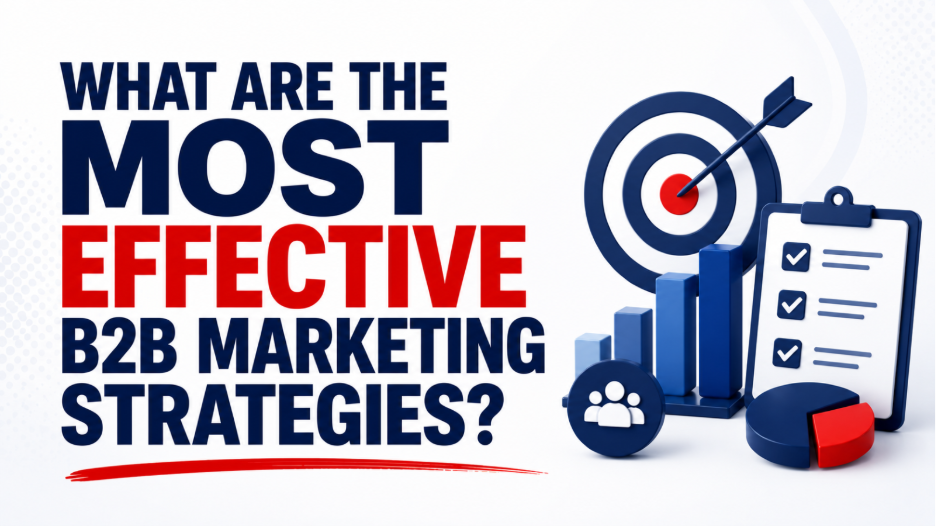
There’s no single “best” approach, since the right combination of B2B marketing strategies depends on your industry, sale complexity, and target audience. That said, several strategies consistently deliver strong results across most B2B sectors.
Account-based marketing (ABM) Rather than casting a wide net, ABM focuses resources on a defined list of high-value target accounts, with personalized messaging and campaigns built specifically for each one. This is one of the most effective B2B marketing strategies for companies with high deal values and relatively few ideal customers.
Content marketing and thought leadership. Publishing in-depth guides, original research, case studies, and expert commentary help establish credibility and educate buyers throughout a long evaluation process. Because B2B buyers often research extensively before ever speaking to a salesperson, strong content fills that gap and builds trust early.
Search engine optimization (SEO). Ranking well for the terms your buyers are actively searching ensures you’re present at the exact moment someone is looking for a solution like yours. Combined with content marketing, SEO is one of the more sustainable, long-term B2B marketing strategies because it continues generating leads without ongoing ad spend.
LinkedIn and social selling. LinkedIn remains the dominant platform for B2B audiences, and strategies built around organic posting, employee advocacy, and targeted advertising tend to outperform broader social platforms for reaching professional decision-makers.
Email marketing and nurture campaigns. Despite being one of the oldest digital channels, email remains among the highest-ROI B2B marketing strategies, particularly for nurturing leads who aren’t ready to buy immediately but need ongoing touchpoints to stay engaged.
Webinars and virtual events. These formats allow companies to demonstrate expertise, showcase products, and engage directly with prospects in a lower-pressure environment than a sales call, often producing highly qualified leads.
Referral and partner marketing. Leveraging existing customers, industry partners, or affiliates to generate warm introductions tends to produce shorter sales cycles, since trust is already partially established before the first conversation.
The strongest B2B strategy typically combines several of these approaches rather than relying on just one, using each to support different stages of the buyer’s journey.
What Are the Different Types of B2B Marketing?
It’s also worth understanding the broader types of B2B marketing, since these categories often overlap with specific strategies but are useful for thinking about your overall approach at a higher level.
Inbound marketing. This type of B2B marketing focuses on attracting buyers through valuable content, SEO, and organic channels, allowing prospects to find you when they’re actively researching solutions. It’s typically slower to build momentum but produces compounding, long-term results.
Outbound marketing. This includes more direct, proactive efforts like cold email, cold calling, and targeted advertising aimed at reaching prospects who may not yet be actively searching for a solution. While sometimes seen as less popular than inbound, outbound remains one of the effective types of B2B marketing for breaking into new markets quickly.
Account-based marketing. As mentioned above, this type of B2B marketing flips the traditional funnel by starting with a specific list of target accounts and building tailored campaigns around them, rather than casting a broad net and filtering down.
Partner and channel marketing. This involves collaborating with resellers, integration partners, or complementary businesses to expand reach, often through co-marketing campaigns, joint webinars, or referral programs.
Event marketing. Whether through industry conferences, trade shows, or company-hosted events, this type of B2B marketing creates face-to-face or live virtual opportunities to build relationships and demonstrate expertise in a more personal setting.
Product-led marketing. Increasingly common in software and tech, this approach uses the product itself, through free trials, freemium models, or interactive demos, as the primary marketing and conversion tool, letting prospects experience value before committing financially.
Most successful companies blend several types of B2B marketing rather than committing exclusively to one, since different buyers and different stages of the sales funnel often respond better to different approaches.
What B2B Marketing Best Practices Should You Follow?
Regardless of which specific tactics or channels you choose, certain B2B marketing best practices consistently separate high-performing teams from the rest.
Align marketing and sales early and often. One of the most important B2B marketing best practices is ensuring marketing and sales teams share the same definition of a qualified lead, communicate regularly, and work from shared goals. Misalignment between these two teams is one of the most common reasons B2B strategies underperform.
Build the full buying committee, not just one person. Since B2B purchases usually involve multiple stakeholders, effective campaigns create content and messaging tailored to each role involved: technical buyers care about specifications and integration, while financial buyers care about ROI and total cost of ownership.
Prioritize quality over quantity in lead generation. Chasing high volumes of unqualified leads wastes both marketing and sales resources. A core B2B marketing best practice is focusing on attracting fewer, better-fit leads rather than maximizing raw numbers.
Invest in case studies and social proof. B2B buyers are inherently risk-averse, since a bad vendor’s choice can reflect poorly on their own judgment. Detailed case studies, testimonials, and reference customers significantly reduce perceived risk and accelerate decision-making.
Use data to guide decisions, not assumptions. Among the most overlooked B2B marketing best practices is committing to consistent measurement: tracking which channels and content actually influence closed deals, not just surface-level engagement metrics like clicks or impressions.
Maintain consistent messaging across every touchpoint. Buyers often interact with a brand across multiple channels, including website, LinkedIn, email, and sales calls, before converting. Ensuring consistent positioning and messaging across all of these touchpoints builds trust and reduces confusion.
Don’t neglect existing customers. Retention, expansion, and referrals from current customers are often more cost-effective than acquiring new ones, yet many companies focus their entire B2B strategy on new logo acquisition while underinvesting in customer marketing.
What B2B Marketing Trends Are Shaping the Industry Right Now?
Staying current with emerging B2B marketing trends is essential, since buyer behavior and available technology continue evolving quickly. Several trends are currently reshaping how companies approach their B2B strategy.
AI-powered personalization at scale. One of the most significant B2B marketing trends is the use of artificial intelligence to personalize content, email sequences, and even website experiences for individual accounts or personas, without requiring manual customization for every single prospect.
Greater emphasis on buyer self-service. Many B2B buyers now prefer to research, compare, and even begin evaluating solutions independently before ever speaking with a salesperson. This trend is pushing companies to invest more heavily in detailed content, transparent pricing, and interactive tools that support self-guided research.
Video and short-form content gain traction. While long-form content remains valuable, more B2B marketers are incorporating short videos, product demos, and bite-sized content formats, particularly on platforms like LinkedIn, to capture attention in increasingly crowded feeds.
Intent data and predictive analytics. Access to intent data, meaning signals indicating when a company is actively researching solutions in your category, is becoming a standard part of modern B2B marketing strategies, allowing teams to prioritize outreach toward accounts already showing buying signals.
Community-driven marketing. Building branded communities, whether through Slack groups, forums, or membership platforms, is emerging as a way to deepen relationships with both prospects and existing customers beyond traditional one-way marketing communication.
Consolidation of martech stacks. As budgets tighten, many companies are simplifying their technology stacks, favoring fewer, more integrated platforms over a patchwork of disconnected tools, which also improves data quality and reporting accuracy.
Increased focus on first-party data. With ongoing changes to cookie tracking and privacy regulations, companies are prioritizing first-party data collection, through gated content, newsletters, and direct customer relationships, rather than relying heavily on third-party tracking.
Keeping an eye on these B2B marketing trends doesn’t mean chasing every new tactic that emerges, but it does mean regularly revisiting your B2B strategy to ensure it still reflects how your buyers actually behave today, rather than how they behaved several years ago.
How Do You Measure the Success of a B2B Strategy?
Even the most well-designed B2B strategy is only as good as your ability to measure whether it’s actually working. Many companies track vanity metrics like website traffic or social media followers, but these numbers don’t always correlate with revenue. Measuring a B2B strategy effectively means connecting marketing activity all the way through to pipeline and closed business.
Marketing qualified leads (MQLs) and sales qualified leads (SQLs). Tracking how many leads move from initial interest to a stage where sales consider them worth pursuing helps identify where the B2B marketing process is working well and where it’s leaking potential customers.
Cost per lead and cost per acquisition. Understanding how much it costs to generate a lead, and ultimately to close a customer, through each channel allows you to compare the efficiency of different B2B marketing strategies and reallocate budget toward what’s actually performing.
Sales cycle length. A shorter average sales cycle often indicates that your content, messaging, and lead nurturing are effectively building trust and answering objections before a prospect ever speaks with sales, reducing the back-and-forth typically needed to close a deal.
Pipeline contribution and revenue attribution. The most meaningful measure of a B2B strategy ties specific campaigns, content pieces, or channels back to actual revenue generated, not just leads captured. This requires solid integration between marketing automation platforms and your CRM.
Customer lifetime value (LTV) and retention. A complete view of B2B marketing success also looks beyond the initial sale, tracking how well acquired customers are retained, expanded, and turned into referral sources over time.
Regularly reviewing these metrics, ideally on a monthly or quarterly basis, allows teams to refine their B2B strategy based on real performance data rather than assumptions about what should be working.
What Common Mistakes Should You Avoid in B2B Marketing?
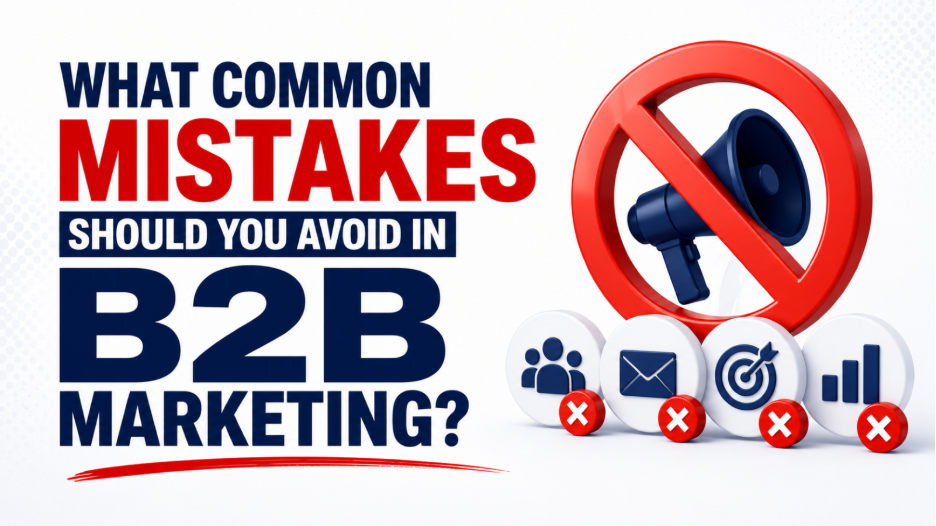
Even experienced marketing teams fall into familiar traps that quietly undermine an otherwise solid B2B strategy. Being aware of these common mistakes can save significant time and budget.
Targeting too broad an audience. Trying to appeal to everyone often means resonating strongly with no one. The most effective B2B marketing strategies are built around a clearly defined ideal customer profile rather than a vague, catch-all target market.
Focusing only on the end user. Since B2B purchases usually involve multiple stakeholders, campaigns that speak exclusively to one persona, often the end user, frequently stall when they reach budget approval or technical evaluation stages involving other decision-makers.
Neglecting sales and marketing alignment. When marketing generates leads using criteria that sales don’t trust or understand, qualified prospects often get ignored or mishandled, wasting the effort that went into generating them in the first place.
Understanding content depth. B2B buyers typically consume far more content before making a purchase decision than consumer buyers do. Thin, generic content rarely builds the trust needed to move a complex; high stakes purchase forward.
Ignoring existing customers in favor of new acquisitions. Many companies pour nearly all their B2B strategy resources into attracting new logos while leaving expansion revenue, renewals, and referrals from happy customers largely untapped, despite these typically being far more cost-effective to pursue.
Failing to revisit strategy regularly. Given how quickly B2B marketing trends and buyer behavior shift, treating your B2B strategy as a fixed, unchanging document rather than a living plan that gets reviewed and adjusted regularly is one of the most common long-term mistakes.
Bringing It All Together
A strong B2B strategy isn’t built from a single tactic or channel. It’s the result of a clear process, a thoughtful mix of strategies and content types, consistent execution of proven best practices, and ongoing attention to emerging trends. Companies that treat their B2B strategy as a living, evolving plan rather than a one-time setup tend to build more predictable pipelines, shorter sales cycles, and stronger long-term customer relationships.
If you’re just getting started, resist the temptation to do everything at once. Pick one or two B2B marketing strategies that align closely with your sales cycle and budget, execute them well, and measure results before expanding into additional channels. A focused B2B strategy executed thoroughly will almost always outperform a scattered approach spread across too many tactics with too little depth behind each one.
It’s also worth remembering that a B2B strategy is never truly “finished.” Markets shift, competitors adjust their own positioning, and buyer expectations continue to evolve alongside new technology and emerging B2B marketing trends. The companies that consistently win in B2B aren’t necessarily the ones with the biggest budgets. They’re the ones who revisit their strategy regularly, pay close attention to what the data is telling them, and stay genuinely close to the problems their customers are trying to solve.
If you’re building or refining your own approach, start by clearly defining your ideal customer and the full B2B marketing process you’ll use to reach them. From there, choose a focused set of B2B marketing strategies that match your sale complexity and audience, draw from the types of B2B marketing that fit your resources and goals, apply proven B2B marketing best practices consistently, and stay alert to B2B marketing trends so your strategy keeps pace with how buyers actually research and decide today. Done well, a B2B strategy becomes less about chasing individual deals and more about building a system that consistently turns the right prospects into long-term customers.



 Get Started