


The wholesale and distribution landscape has never moved faster – or rewarded the bold more generously. While the fundamentals of moving product from manufacturer to retailer haven’t changed, everything surrounding that core transaction has been rebuilt from the ground up. The buyers have changed. The channels have changed. The expectations have changed. And for wholesalers and distributors who still rely on relationships alone, old catalogs, and phone-in orders, the warning signs are impossible to ignore.
The good news? The same transformation that threatens legacy players is creating extraordinary opportunities for those with the right B2B strategy. The businesses winning today are not necessarily the largest or the most established. They are the ones who understand where modern buyers are, what they expect when they arrive, and how to deliver an experience that keeps them coming back – repeatedly and at growing order values.
This guide lays out the operational, digital, and relational playbook for wholesalers and distributors who want to win more customers, drive revenue growth, and build a distribution business that scales without breaking.
The Market Reality: Why Your B2B Strategy Must Evolve Now
Before getting into tactics, it’s worth understanding the magnitude of what’s happening in the distribution sector. The numbers are staggering.
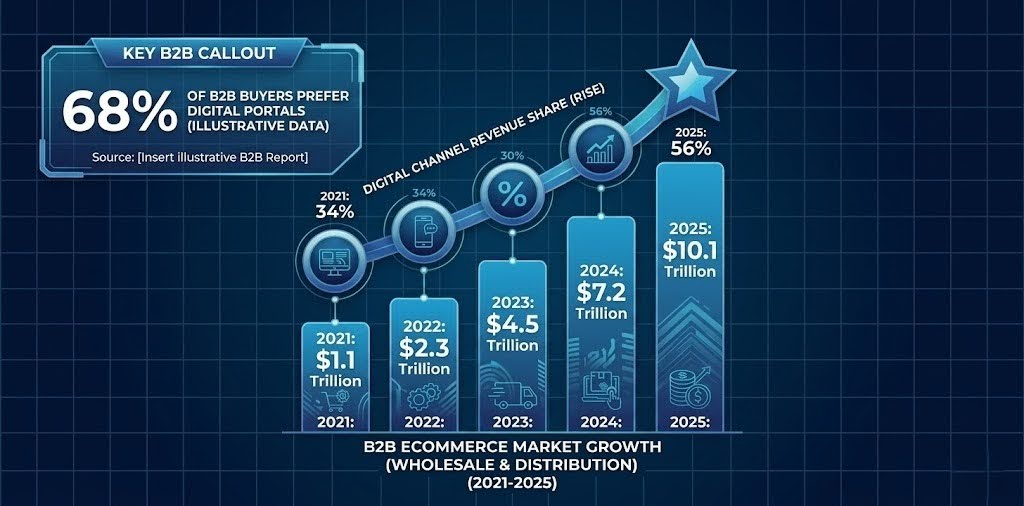
U.S. B2B ecommerce sales reached $9.69 trillion in 2024, representing 8.56% growth year over year [Capital One Shopping Research, 2025]. By 2025, that figure climbed to $10.1 trillion, with manufacturers and merchant wholesalers projected to generate $8.81 trillion in ecommerce sales by year-end [Capital One Shopping Research / Statista, 2025]. Perhaps most telling, 86.6% of all ecommerce in the country is B2B, dwarfing the 12.1% attributed to retail B2C [Capital One Shopping Research, 2025]. This isn’t a niche segment. This is the main event.
And yet, the channel shift is still accelerating. Just a few years ago, roughly 34% of B2B company revenue came from digital channels. Today that figure sits at 56% and continues to climb [Statista, 2024]. Gartner’s earlier prediction that 80% of B2B sales interactions would occur digitally by 2025 has effectively been confirmed [Gartner / OmniBound B2B Buying Statistics, 2026].
What does this mean for your B2B strategy as a distributor or wholesaler? It means the window for gradual adoption is closed. Businesses that treat digital as supplemental, not central, are ceding ground to competitors who have already made the investment. The question is no longer whether to go digital. It’s how fast you can do it well.
Pillar One: Know Your Buyer – The Modern Procurement Manager Has Changed
One of the most consequential shifts in wholesale distribution is who is sitting across the table – and what they expect. The millennial generation now makes up a significant portion of B2B buying committees, and their purchasing instincts were forged in a world of one-click checkout, instant product comparisons, and transparent pricing.
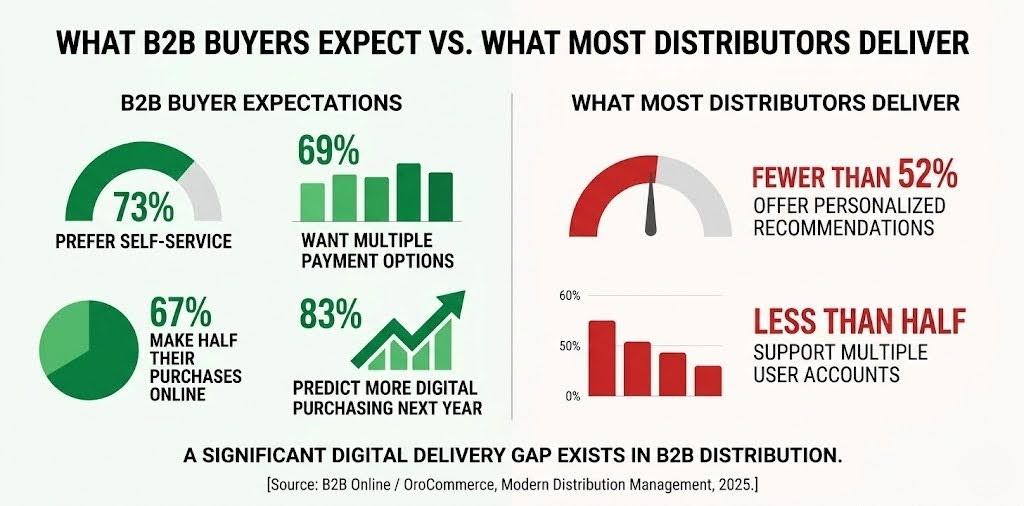
Consider this: 73% of B2B buyers are millennials who strongly prefer online self-service ordering over working through a traditional sales rep [Swell, B2B Marketplace Trends, 2025]. A separate survey by Sana Commerce found that 73% of businesses now prefer making purchases online overall [Digital Commerce 360 / Sana Commerce, 2025]. These aren’t fringe preferences. They represent a generational reset of expectations that your B2B strategy has to accommodate.
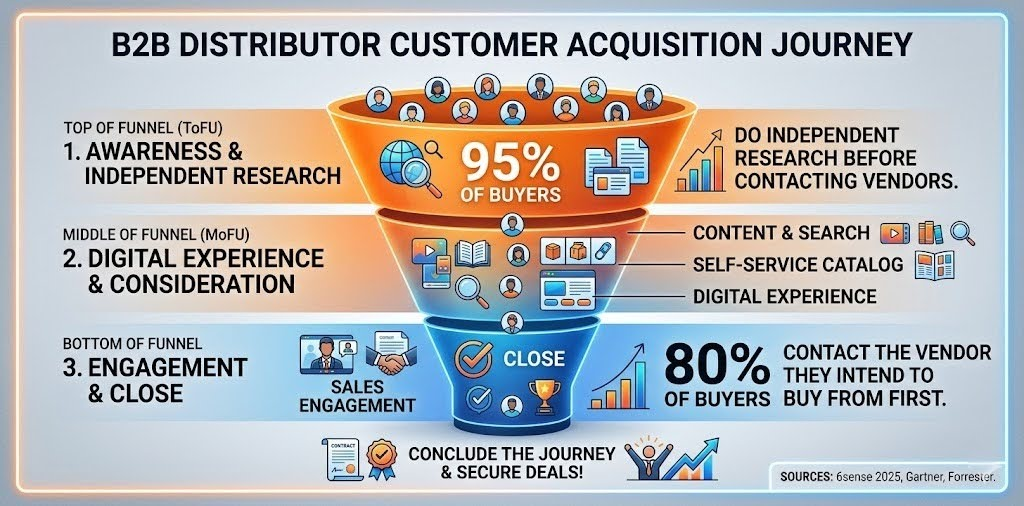
What’s more, today’s buyers don’t want to be engaged by sales at the start of the journey. Two-thirds of B2B buyers now prefer engaging salespeople only in the later stages of the purchase process, up 17 percentage points from just a year prior [Forrester / OmniBound, 2026]. They’ve already done their research. By the time they reach out, 95% of buyers already have a Day-One shortlist – and 80% contact the vendor they intend to buy from first [6sense, 2025 Buyer Experience Report].
This has radical implications for your go-to-market approach. If you aren’t visible and compelling before the buyer picks up the phone, you may already be out of the running.
What winning distributors do differently:
They invest in content that educates buyers during the research phase – product comparison pages, category-level buying guides, and transparent pricing tiers that let procurement managers self-qualify and self-serve. They make digital reordering frictionless. They ensure their catalog is searchable, their inventory status is real-time, and their checkout handles the complexity of bulk pricing, tiered discounts, and purchase order-based payment. And critically, they build sales teams that specialize in deepening relationships and expanding accounts – not just closing first orders.
Pillar Two: Your Digital Storefront Is Your Highest-Performing Sales Rep
For distributors still treating their website as a brochure, here’s a useful reframe: your digital storefront is now your most scalable, always-on, cost-effective sales representative. It handles thousands of inquiries simultaneously, never asks for a commission, and serves buyers in every time zone at 3:00 a.m. on a Sunday.
But most B2B digital experiences in distribution are falling short. Recent research from B2B Online and OroCommerce found that while 67% of buyers now make at least half of their purchases online, fewer than half of distributor portals support multiple user accounts, and only 52% of buyers report receiving personalized product recommendations [Modern Distribution Management / B2B Online and OroCommerce, 2025]. That means nearly half of all wholesale buyers are navigating a digital channel that doesn’t know who they are, doesn’t remember their preferences, and forces them to repeat the same steps they completed months ago.
This is an enormous competitive gap – and an equally large opportunity. The distributors who close it fastest will command loyalty that’s nearly impossible for competitors to disrupt.
A strong B2B strategy for digital growth includes the following non-negotiables:
- Catalog and pricing architecture: Your online catalog needs to handle the complexity distributors actually deal with – tiered pricing by volume, contract-specific pricing by customer, and product variants without forcing buyers to call for clarification. Buyers making high-value purchases need to see the right price instantly.
- Self-service account management: Buyers want to see their order history, reorder past purchases, track shipments, download invoices, and manage their own team’s purchasing access without human intervention. 70% of B2B decision-makers are willing to spend up to $500,000 in a single ecommerce transaction [Swell, 2025]. That’s not a small purchase. Those buyers expect an enterprise-grade self-service experience.
- Search and discoverability: A distributor’s catalog can run into the tens of thousands of SKUs. If your search function returns irrelevant results, buyers don’t call – they leave. Invest in search infrastructure that understands product categories, part numbers, synonyms, and cross-references.
- Mobile optimization: In 2020, 87% of B2B buyers were connecting to vendor platforms via mobile apps for work-related purchasing [Episerver / Klizer, 2024]. That percentage has only grown. A mobile experience that’s clunky or incomplete is no longer acceptable.
Pillar Three: Pricing, Promotions, and the Margin Game
In distribution, margin discipline is existential. Compete on price alone and you’re in a race to the bottom. But ignore pricing strategy entirely and you’ll lose volume to competitors who are smarter about when and how they discount.
The most successful wholesalers are not the cheapest. They’re the most strategic. Here’s what that looks like in practice.
- Volume-based incentives that drive basket size: Rather than flat discounting across all products, structure your pricing tiers to reward volume in ways that naturally grow average order values. When a buyer sees they’re $800 away from the next pricing tier, they’ll often make up the difference – especially on fast-moving goods.
- Seasonal and event-based promotions: Distribution has its own version of promotional calendars. Whether it’s pre-season stocking runs, trade show tie-ins, or end-of-quarter clearance on aging inventory, planned promotions that are communicated proactively create urgency and give sales reps a reason to reach out. These campaigns, when executed digitally, become scalable and trackable.
- Loyalty programs for B2B: Consumer brands have long understood that loyalty drives retention. Distribution is finally catching up. Account-level loyalty programs – where cumulative spend unlocks rebates, extended payment terms, or early access to new product lines – are one of the most effective tools available for reducing churn among your best accounts.
- Transparent contract pricing: Nothing erodes buyer trust faster than discovering they could have gotten a better rate. Build transparency into your pricing architecture and ensure each buyer sees their negotiated price every time they log in. Consistency builds confidence; inconsistency breeds suspicion.
Pillar Four: Customer Acquisition – Building a Pipeline That Doesn’t Depend on Referrals
Many distributors built their book of business on referrals and trade relationships. That foundation is valuable – but it’s also fragile. When a long-tenured rep retires or a key account consolidates suppliers, the pipeline dries up with very little warning.
A resilient B2B strategy for customer acquisition has multiple channels working in parallel, not a single dependency.
- Inbound content marketing: Buyers are searching for information before they’re searching for vendors. Creating educational content – buying guides, product comparison resources, industry benchmarking reports, and how-to explainers – positions your business as the expert in your category. When a procurement manager types “how to evaluate industrial supply distributors” into a search engine, the distributor whose content appears first earns the trust of that buyer before a competitor has even had the chance to speak with them.
- Marketplace presence: American B2B marketplace sales surged 519% between 2021 and 2024 [Swell, 2025]. Marketplace platforms commanded 65% of B2B ecommerce activity in 2024, representing $21.3 trillion in transaction value [Swell, B2B Marketplace Trends, 2025]. For distributors, having a presence on relevant wholesale marketplaces isn’t a threat to owned channels – it’s a customer acquisition engine that reaches buyers who wouldn’t have found you otherwise.
- Outbound with precision: Cold outreach still works, but only when it’s targeted and relevant. Modern outbound in distribution means using purchase data, industry segmentation, and company size criteria to identify accounts with a high probability of fit – then reaching out with a message specific to their business type and buying patterns. Generic email blasts are not a B2B strategy. Targeted, research-backed outreach is.
- Trade events and vertical community: Industry trade shows and association events remain powerful for B2B relationship development. But the best distributors don’t just attend – they speak, sponsor, and build presence. Demonstrating expertise in front of a room full of buyers establishes authority in ways that digital channels alone cannot replicate.
Pillar Five: Retention, Expansion, and the Lifetime Value Equation
In distribution, the real profitability is not in the first order. It’s in order number two, five, and twenty-seven. Customer acquisition is expensive. Retention is where margin lives.The data makes this viscerally clear: companies with strong omnichannel engagement strategies retain 89% of their customers, compared to just 33% retention for those without [Swell, B2B Marketplace Trends, 2025]. That’s not a modest gap. That’s the difference between a thriving distribution business and one that’s constantly running to fill the bucket it’s leaking.
- Account-based expansion: Your best new customers are often your existing ones. Map your accounts by current penetration – which product categories does each customer buy from you, and which do they source from competitors? The gaps in that map represent addressable revenue that doesn’t require a single new customer acquisition.
- Dedicated account management: As accounts grow past a meaningful revenue threshold, assign them a dedicated rep whose job is proactive outreach, not just problem resolution. Regular business reviews, custom reporting on their purchasing patterns, and early access to new product introductions make accounts feel valued – and much harder to displace.
- Feedback loops and product requests: Distributors who involve their top accounts in decisions about product additions, catalog expansions, or service improvements build a sense of shared ownership that is extraordinarily sticky. When a buyer helped shape your offering, they’re invested in your success.
- Reorder automation and smart replenishment: One of the highest-leverage features a distributor can offer is the ability to automate recurring orders. When a buyer can set a recurring purchase for fast-moving inventory and trust that it will arrive reliably, they stop shopping for alternatives. The cognitive load of procurement shrinks, and switching costs rise significantly.
Pillar Six: Operations and Technology – The Infrastructure Behind Your Growth
A winning B2B strategy doesn’t just live in sales and marketing. It runs on operational infrastructure that can support scale without proportional headcount growth. This is where technology choices become strategic decisions.
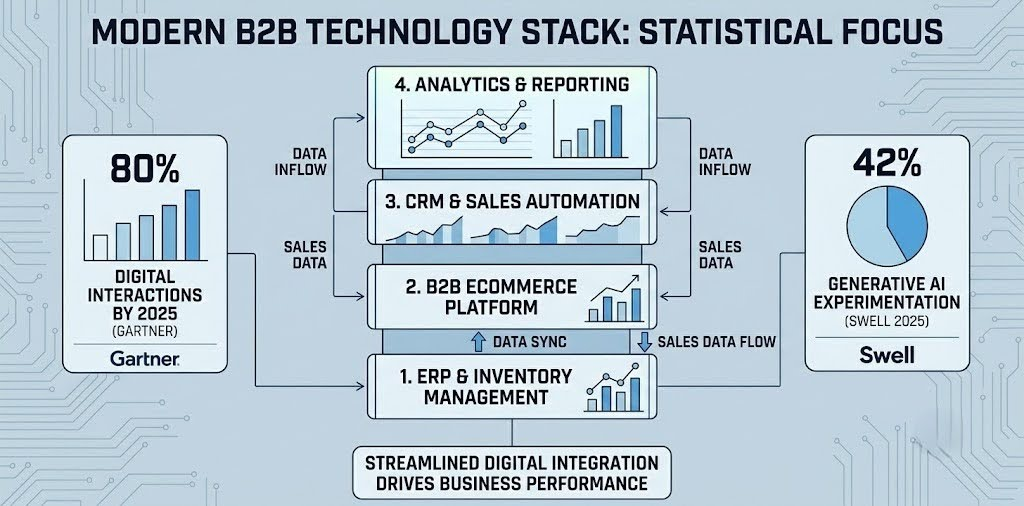
- ERP and inventory integration: Your digital storefront is only as trustworthy as the inventory data behind it. When a buyer places an order for 500 units and later discovers 200 of them are backordered, they lose trust – not just in a product, but in your systems. Real-time inventory sync between your warehouse management system and your customer-facing catalog is non-negotiable for distribution businesses operating at scale.
- CRM for account intelligence: Distribution sales cycles are not one-time transactions. They’re relationships that span years and dozens of touchpoints. A CRM that tracks account history, flags at-risk accounts based on declining order frequency, surfaces expansion opportunities, and feeds data into your outbound motion is essential infrastructure for any serious B2B strategy.
- Generative AI and automation: 42% of B2B sales forces are currently implementing or experimenting with generative AI [Swell, B2B Marketplace Trends, 2025]. For distributors, the near-term applications are concrete and valuable: AI-powered product search, automated order confirmation and status updates, dynamic pricing recommendations, and intelligent upsell suggestions based on purchase history. These aren’t science fiction applications – they’re capabilities available in today’s platforms.
- Analytics and reporting: You cannot optimize what you cannot measure. Distribution businesses that invest in unified reporting – tracking digital channel performance, account-level profitability, catalog performance by SKU, and sales team effectiveness – can make decisions based on evidence rather than instinct. The gap between data-driven distributors and those operating on gut feel is widening every year.
Pillar Seven: Scaling From Regional to National – What Changes and What Doesn’t
Many successful distributors reach a point where regional dominance is no longer enough – but the path from regional to national scale is filled with landmines that have ended more than a few growth stories prematurely.
The core B2B strategy for geographic expansion in distribution involves three phases: market research and validation, operational readiness, and channel activation.
- Market research and validation: Not every region is equally attractive for every product category. Before investing in warehouse capacity, local logistics partnerships, or sales team buildouts in a new geography, validate demand. Digital channels make this easier than ever – you can run geo-targeted advertising campaigns or enable online ordering in a new region before committing to physical infrastructure and measure real buyer interest against your assumptions.
- Operational readiness: Scaling geographically without operational readiness is one of the fastest ways to damage a reputation built over years. Lead times, fill rates, and damage rates in distribution are the metrics buyers live and die by. If your new geographic footprint can’t match the service levels your existing customers expect, you’ll win accounts in the short term and lose them permanently in the medium term.
- Channel activation: New markets typically require a blend of outbound prospecting, marketplace presence, digital advertising targeting relevant buyer intent signals, and attendance at regional trade events. The most successful expansions layer these channels in a logical sequence – build awareness before pursuing meetings, build credibility before asking for large first orders.
Building Your B2B Strategy Roadmap: Where to Start
The principles in this guide represent a comprehensive operating system for wholesale and distribution businesses that want to grow. But a roadmap without prioritization is just an overwhelming list.
If you’re early in your digital transformation, start with your digital storefront and catalog experience. That’s the foundation everything else builds on. If you’ve already invested in ecommerce infrastructure, the highest-leverage next move is typically the retention and expansion engine – building account management programs and reorder automation that keep your best customers ordering more, more often.
If you’re at a growth stage and looking to add a new customer acquisition channel, content-driven inbound marketing and marketplace presence offer the best return for the investment required.
And throughout all of it, keep measurement at the center. A strong B2B strategy is not a document you write once – it’s a living system that improves as data accumulates. The businesses that compound their advantage year over year are the ones that learn faster than their competitors, iterate more deliberately, and never mistake activity for progress.
The wholesale and distribution businesses that will define the next decade are building their advantage right now. The market is large enough, and the digital transformation is accelerating enough, that there is still room for determined players to claim significant positions. But the window is not indefinitely open.
Your B2B strategy starts with a decision: to operate the business you have, or to build the business you want. The playbook above is designed for the second kind.
- What is B2B business strategy?
A B2B strategy is a plan that guides how a business sells its products or services to other businesses rather than individual consumers. It covers how you attract, convert, and retain business clients through pricing, sales channels, marketing, and operations.
- What is the 3-3-3 rule in sales?
The 3-3-3 rule means reaching out to 3 prospects, following up 3 times, and doing so within 3 days to maximize response rates. It’s a simple cadence framework that keeps sales outreach consistent and timely without overwhelming potential buyers.
- What is B2B, B2C, C2B, C2C, d2c?
These are business models defining who sells to whom — B2B (business to business), B2C (business to consumer), C2B (consumer to business, like freelancers), C2C (consumer to consumer, like marketplace resellers), and D2C (brand selling directly to end consumer, bypassing distributors). Each model has different sales cycles, pricing strategies, and customer relationship dynamics.
- What are the 4 types of B2B marketing?
The 4 types of B2B marketing are product marketing, content marketing, account-based marketing (ABM), and demand generation. Each serves a different purpose — from building awareness and educating buyers to targeting high-value accounts and driving measurable pipeline growth.
- What is the 3 3 3 rule in marketing?
The 3-3-3 rule in marketing means capturing attention in 3 seconds, delivering your core message in 3 sentences, and including 3 key points or calls to action. It’s a framework for creating concise, high-impact messaging that respects the short attention span of modern buyers.


 Get Started