

If you run wholesale or distribution operations, you already know the challenge: your buyers are professional, time-pressed, and skeptical. They don’t browse Instagram looking for their next supplier. They don’t click banner ads. And they definitely don’t fill out a lead form just because you ran a Google search campaign. Yet your pipeline still needs to be full, your catalog needs to move, and your retailer relationships need to grow.
That’s exactly why B2B advertising in 2026 looks nothing like it did five years ago – and why wholesalers and distributors who are still running the same playbook are quietly losing ground to competitors who’ve figured out what actually works. This guide breaks down the strategies, the data, and the real-world moves that separate top-performing distribution companies from everyone else.
Why Traditional B2B Advertising No Longer Cuts It for Distributors
For most of the last decade, wholesale marketing meant trade show booths, cold email blasts, and maybe a rep who worked the phone. For distributors and wholesalers, that was enough. You had long-standing relationships, exclusive territories, and buyers who had limited alternatives.
That world is gone.
According to the Gartner 2024 B2B Buyer Survey, 75% of B2B buyers now prefer a rep-free sales experience – meaning they want to research, evaluate, and even purchase without talking to a salesperson until they’re practically ready to sign. [Gartner, “Future of B2B Buying,” 2024] Meanwhile, the number of digital touchpoints a buyer interacts with before making a vendor decision has climbed to an average of 27, up from 17 in 2021. [Forrester Research, “B2B Buying Journey,” 2024]
For wholesalers and distributors specifically, this shift is even more pronounced. Your buyers – retail store owners, purchasing managers, procurement teams – are making decisions online first. They’re comparing your catalog, your pricing model, your delivery reliability, and your content authority before they ever pick up the phone.
This means B2B advertising is no longer just about awareness. It’s about creating a digital presence that earns trust, communicates value, and moves buyers through a decision journey that’s increasingly self-directed.
The B2B Advertising Landscape in 2026: What the Data Says
Before diving into tactics, let’s ground this in what’s actually happening across the B2B landscape right now.
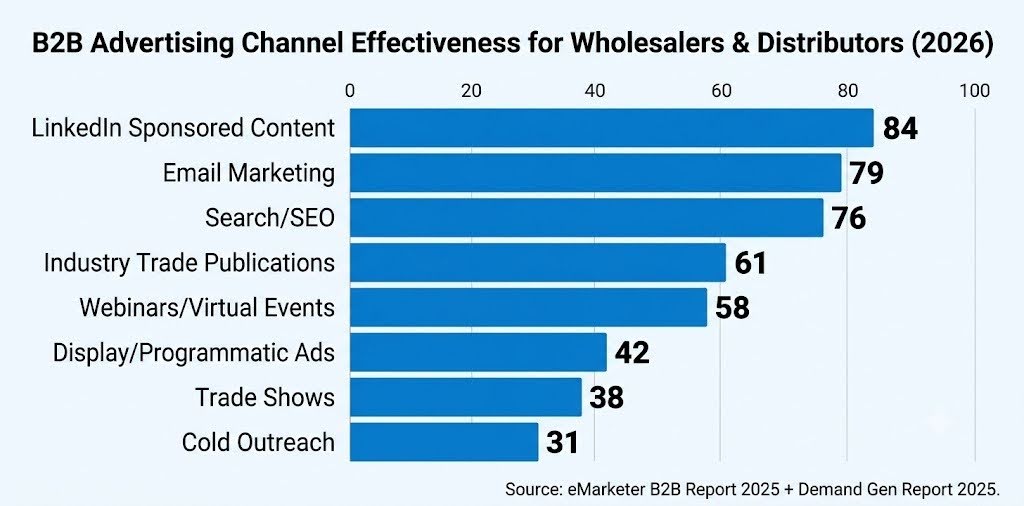
U.S. B2B digital advertising spend crossed $18.5 billion in 2025 and is projected to reach $21.3 billion by the end of 2026. [eMarketer, “US B2B Digital Ad Spending,” 2025] But the spend doesn’t tell the whole story. The more interesting number is where that spend is going – and more importantly, where top-performing companies are choosing to put their money versus where average performers are stuck.
Research from Demand Gen Report shows that 68% of high-growth B2B companies allocate at least 40% of their advertising budget to content-driven formats (guides, case studies, educational videos, webinars), compared to just 29% of average-growth companies that still concentrate on direct-response formats. [Demand Gen Report, “2025 B2B Content Preferences Study”] For distributors, this is a massive signal: the companies winning new retailer accounts and growing wholesale volume aren’t necessarily outspending competitors – they’re out-educating them.
LinkedIn remains the dominant paid channel for wholesale and distribution outreach, with 4 out of 5 B2B leads on social media coming from LinkedIn specifically. [LinkedIn Marketing Solutions, “The B2B Marketing Benchmark,” 2025] For distributors targeting purchasing managers, category buyers, and retail chain operators, this concentration matters. It means your buyers are reachable – you just need the right message in the right format.
What Top-Performing Distributors Do Differently: 6 Key Strategies
1. They Treat Content as Infrastructure, Not a Campaign
Most distributors think about advertising in bursts – a campaign before a trade show, a promotion before the holiday season, a product launch push. Top performers think differently. They treat content as permanent infrastructure: assets that generate inbound interest 24/7, 365.
The highest-ROI B2B advertising asset for wholesalers and distributors consistently turns out to be the long-form guide or resource page. Companies that maintain active resource hubs – with buyer guides, product comparison tools, ordering tutorials, and market trend reports – generate 3x more inbound leads than companies that rely on outbound campaigns alone. [HubSpot, “State of Inbound Marketing,” 2025]
What this looks like practically: a distributor of health and wellness products might publish a “Retailer’s Complete Guide to Stocking Supplements in 2026,” targeting the exact keyword searches that purchasing managers use when they’re evaluating new product categories. That single piece of content, properly optimized, becomes a lead-generation asset for years.
This is a core principle of B2B advertising that most distribution companies underinvest in: organic content compounds, while paid campaigns expire.
2. They Segment and Target by Buyer Role, Not Just Industry
One of the most common mistakes distributors make in paid outreach is treating “the buyer” as a monolithic figure. In reality, the path to a new wholesale account involves multiple people: the store owner or GM, the category manager, the buyer or purchasing agent, and sometimes a finance approval layer. Each of these roles has different information needs, different objections, and different platforms where they spend time.
Top-performing companies in distribution build what marketers call “role-based” advertising. Their LinkedIn campaigns run different creative for “store owners” versus “procurement managers.” Their email sequences send different content to “first-time inquiry leads” versus “reorder prospects.” Their landing pages are dynamically adjusted based on what segment the visitor came from.
The payoff is real: personalized B2B advertising campaigns generate 202% higher engagement than generic broadcasts, according to research by Demand Metric. [Demand Metric, “Content Marketing Infographic,” 2024] For distributors whose average deal size can range from $5,000 to $500,000 depending on retailer scale, even a marginal improvement in conversion rate from prospect to qualified account has enormous dollar value.
3. They Invest Heavily in Paid LinkedIn Before Earned Reputation Is Built
For newer distributors or those entering new product categories, organic reach takes time. Top performers bridge this gap with a deliberate paid LinkedIn strategy that most competitors are running incorrectly.
The mistake most B2B advertising teams make on LinkedIn is running brand awareness campaigns with vague messaging – “Leading distributor of X, trusted by hundreds of retailers.” Buyers don’t respond to that. What they respond to is specificity and proof.
The top-performing LinkedIn ad formats for distributors in 2025–2026 are: Thought Leadership ads (boosted posts from company executives or subject matter experts), Lead Gen Forms with gated guides or tools, and Document Ads that let buyers preview a catalog or guide before downloading. [LinkedIn Marketing Solutions, “B2B Campaign Performance Benchmarks,” 2025]
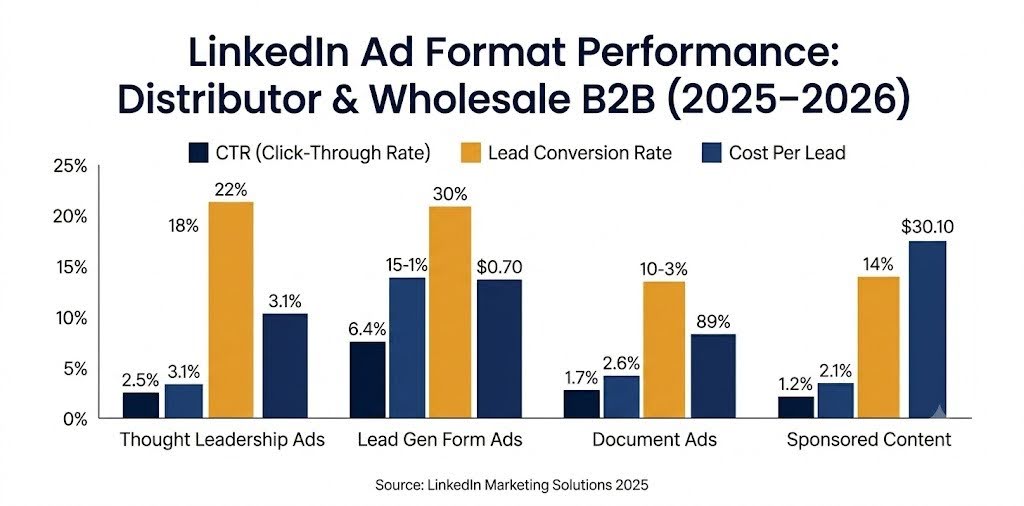
Average cost-per-lead on LinkedIn for B2B companies runs between $75 and $150, which sounds high compared to Google Display or Facebook. But when you’re selling wholesale accounts where a single converted client generates $50,000+ in annual revenue, a $120 CPL on LinkedIn is one of the most efficient marketing dollars available. [HubSpot, “LinkedIn Ads Benchmarks for B2B,” 2025]
4. They Build Retargeting Funnels Specifically for Long B2B Sales Cycles
The B2B buying cycle for wholesale distribution accounts is long – often 3 to 6 months from first engagement to first purchase order. This is one of the biggest reasons B2B advertising fails for distributors: they run a campaign, get some impressions, and then the prospect disappears into a long evaluation phase with no follow-up touchpoints.
Top performers solve this with layered retargeting. The structure looks roughly like this:
First, a cold awareness campaign reaches a defined audience – purchasing managers, retail operators, or category buyers in a specific geography or industry segment. Some percentage engages: they click, they visit a product page, they download a catalog.
Second, retargeting begins. Anyone who engaged with the top-of-funnel content now sees a different message – a case study, a testimonial from a similar retailer, a limited-time onboarding promotion.
Third, leads who respond to the mid-funnel retargeting get moved into a high-intent nurture sequence, often a combination of email and LinkedIn InMail, that moves them toward a demo or sample order.
Companies that implement this three-stage retargeting funnel reduce their average cost-per-acquisition by 47% compared to single-touch promotional campaigns. [WordStream, “B2B Retargeting Benchmarks,” 2024] For distributors dealing with stretched marketing budgets, this efficiency gain is not optional – it’s essential.
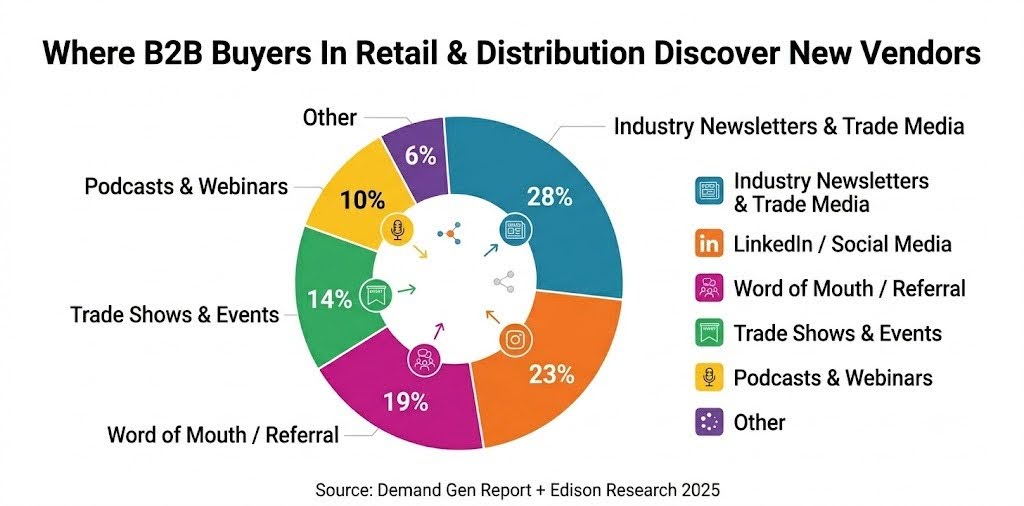
5. They Use Trade Publication and Podcast Advertising to Build Category Authority
Here’s the counterintuitive move that the best distribution companies are making while their competitors fight over LinkedIn impressions: they’re going back to industry media – but in a smarter, more integrated way.
Trade publications serving retail, grocery, pharmacy, hardware, or specialty channels still command deep attention from exactly the buyers that distributors need to reach. What’s changed is how top performers are advertising in these channels. Instead of product ads or banner placements, they’re buying sponsored content, editorial partnerships, and contributed articles that position their company as a market intelligence source, not just a vendor.
The same logic applies to the explosion of B2B podcasts in the retail and distribution space. According to Edison Research, 62% of B2B decision-makers consume industry podcasts at least monthly, and podcast advertising in wholesale-adjacent channels generates higher recall rates than any other digital format. [Edison Research, “The Infinite Dial,” 2025] A 60-second mid-roll mention in a podcast listened to by 10,000 retail buyers is worth more to a distributor than 100,000 LinkedIn impressions from an audience that hasn’t self-selected into your category.
6. They Align Advertising Spend with Ordering Season and Retailer Calendar
This one sounds obvious but is almost universally ignored by mid-market distributors: the most effective B2B advertising campaigns for wholesalers are timed to buyer readiness, not company convenience.
Retailers plan their inventory and make major vendor decisions at specific points in the year – pre-season buying cycles for holiday, back-to-school, or category resets are defined windows. Top-performing distributors run heavier advertising pressure in the 6–8 weeks before these decision windows, when buyers are actively evaluating options, rather than spreading budget evenly across the calendar.
Research from Forrester confirms that B2B companies that align campaign timing to buyer decision windows see a 34% improvement in campaign ROI versus those that run “always-on” undifferentiated spend. [Forrester Research, “B2B Marketing Planning Guide,” 2024] The practical implication for distributors: build your marketing calendar backward from your buyers’ buying calendar, not forward from your product launch schedule.
The Measurement Framework That Actually Matters
One of the most persistent problems in B2B advertising for distribution companies is measurement. Because the sales cycle is long and multi-touch, most distributors end up measuring the wrong things – impressions, clicks, open rates – and optimizing for metrics that don’t actually correlate with revenue.
Top performers measure differently. They track:
Pipeline velocity – how fast leads move from first content interaction to sales qualified lead. If your content is working, this number should be improving over time.
Multi-touch attribution – not just last-click, but which combination of touchpoints (LinkedIn ad + guide download + email sequence + trade show follow-up) is most predictive of a closed wholesale account.
Account-level engagement – using tools like LinkedIn’s company targeting or ABM platforms to track whether specific target accounts are engaging with your content, even before they raise their hand.
Content-assisted revenue – the percentage of closed deals where the buyer interacted with at least one piece of content before becoming a customer. For top distributors, this number typically exceeds 70%. [Demand Gen Report, “2025 Revenue Marketing Study”]
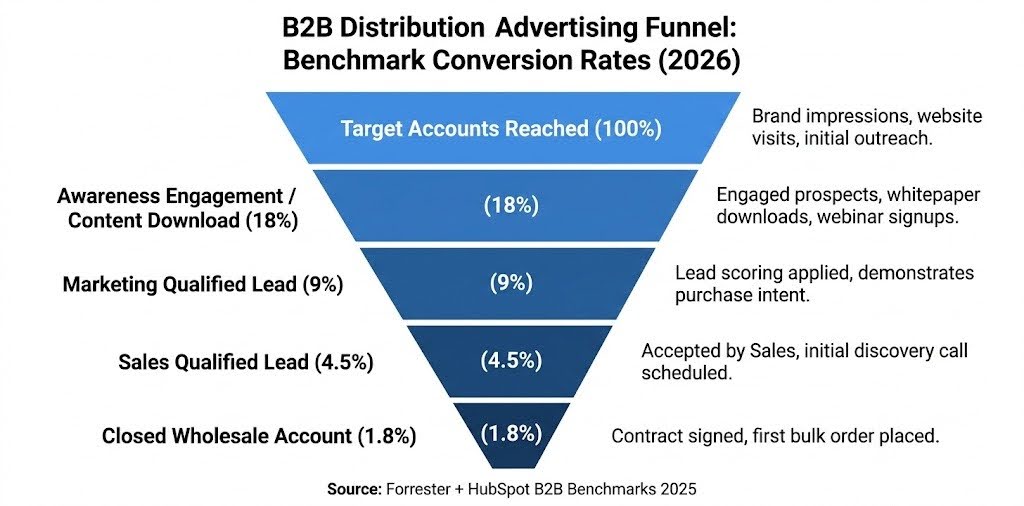
The gap between top-performing and average-performing distributors isn’t primarily a budget gap. Companies in the top quartile of B2B advertising performance in wholesale and distribution spend an average of $1,200 per qualified lead and generate accounts worth $65,000+ in first-year revenue. Companies in the bottom two quartiles spend an average of $2,800 per qualified lead and generate accounts worth $18,000 in first-year revenue. [Forrester Research, “B2B Marketing ROI Study,” 2025] The difference isn’t how much they spend – it’s how systematically they think about who they’re reaching, what they’re saying, and when.
Building Your 2026 B2B Advertising Playbook: A Practical Starting Point
If you’re a wholesaler or distributor looking to put these principles into practice, the priority stack should look something like this:
Start by auditing your current content assets. What do you have that a purchasing manager or retail buyer would actually find valuable? A well-organized product catalog is not content. A guide called “How to Successfully Introduce a New Category to Your Store Floor” is content. The gap between those two is where your B2B advertising strategy either wins or loses.
Second, lock in your audience segments and build LinkedIn campaign audiences around them before you spend a dollar on creative. Job title targeting, company size filters, and industry layers on LinkedIn are your most powerful tools for reaching the right buyers – and they need to be right before the messaging conversation starts.
Third, build your retargeting infrastructure before you run top-of-funnel campaigns. The most common waste in distribution marketing is paying to reach buyers, getting them to engage, and then having nothing to say to them after that first interaction. Your retargeting sequences – mid-funnel case studies, proof-points, specific category playbooks – should be live before you open the awareness tap.
Fourth, connect your advertising strategy to your sales calendar. What are the three most important buying windows for your retail partners this year? Plan your advertising pressure around those windows, and you’ll be competing for attention at exactly the moment buyers are most receptive.
Finally, commit to measuring pipeline metrics, not vanity metrics. Monthly reporting on CPL, pipeline velocity, and content-assisted revenue should be non-negotiable for any distribution company serious about making B2B advertising a predictable growth driver rather than an unpredictable expense.
What Separates the Leaders: A Final Data Point
The single biggest predictor of B2B advertising success for wholesalers and distributors in 2026 isn’t budget, isn’t team size, and isn’t technology stack. It’s consistency of investment in buyer education over time.
According to Content Marketing Institute’s 2025 B2B research, organizations that have maintained a consistent content and advertising strategy for 3+ years generate 4.2x more qualified leads per dollar spent than organizations in their first year of content-driven advertising. [Content Marketing Institute, “B2B Content Marketing Report,” 2025] The compounding effect of authority, SEO equity, and brand familiarity built through consistent digital outreach is not something you can shortcut with a burst campaign.
For distribution companies competing in a market where buyers have more choices, more information, and less patience than ever, the message is clear: the playbook that wins is built on education, precision targeting, long-cycle nurturing, and relentless measurement. The distributors who commit to this approach consistently – not just when pipeline is light – are the ones who will be capturing market share while their competitors are still wondering why their trade show investment stopped working.
The numbers don’t lie. The strategy is there. The only question left is whether you’re ready to execute it.
- What does B2B mean in advertising?
B2B (Business-to-Business) advertising refers to marketing products or services from one business to another. It focuses on reaching professional buyers, decision-makers, and procurement teams rather than individual consumers.
- What is the 3 3 3 rule in sales?
The 3-3-3 rule in sales is a prospecting framework where salespeople aim to make 3 calls, send 3 emails, and connect with 3 prospects each day (or within a set period) to maintain consistent outreach and pipeline growth.
Note: Different organizations may define the 3-3-3 rule differently, but it generally emphasizes consistent and balanced sales activity.
- What are the 4 types of B2B?
The 4 main types of B2B businesses are:
- Producers – Businesses that buy goods or services to create other products.
- Resellers – Companies that purchase products and sell them to customers for profit.
- Governments – Public sector organizations that procure goods and services from businesses.
- Institutions – Nonprofits, schools, hospitals, and other organizations that buy products or services to support their operations.
- What is B2B, B2C, C2B, C2C, d2c?
B2B, B2C, C2B, C2C, and D2C are different business models that describe who is selling to whom.
B2B = Business to Business, B2C = Business to Consumer, C2B = Consumer to Business, C2C = Consumer to Consumer, and D2C = Direct-to-Consumer.
- What are the 4 types of business models?
The four main business models are B2B (Business-to-Business), B2C (Business-to-Consumer), C2B (Consumer-to-Business), and C2C (Consumer-to-Consumer).
Each model defines how products or services are exchanged between businesses and consumers.


 Get Started