B2B distribution is the business of buying goods in bulk from manufacturers and selling them on to other businesses – typically retailers, but also restaurants, contractors, institutions and other distributors. The distributor takes ownership of the stock, holds it in a warehouse, breaks it into smaller quantities, and delivers it to buyers who cannot or do not want to purchase directly from the manufacturer.
Key facts at a glance
- Definition: the bulk purchase, warehousing and onward sale of goods from manufacturers to business buyers.
- Who does it: distributors, wholesalers and importers.
- Who buys: retailers, foodservice, contractors, institutions, resellers.
- How money is made: on the margin between buying price and selling price, not on commission.
- Key difference from a marketplace: a distributor takes ownership of inventory and carries the risk.
- Four main models: exclusive, selective, intensive and direct distribution.
How B2B Distribution Works
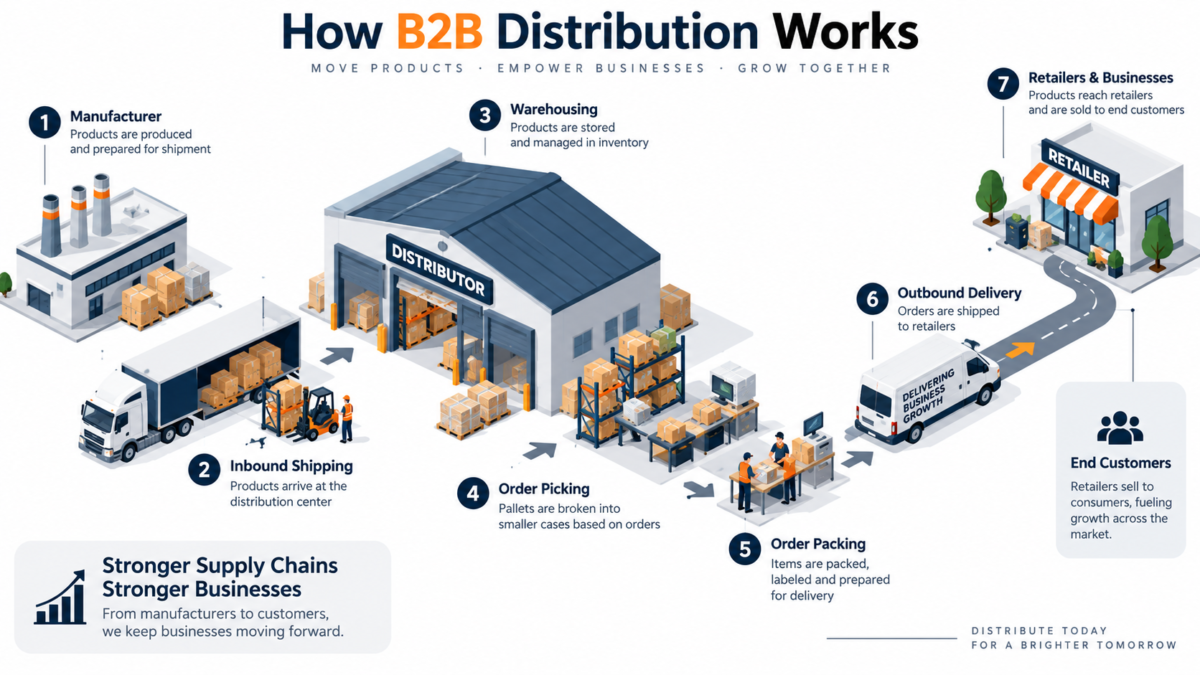
The core function of a distributor is breaking bulk. A manufacturer wants to produce and ship in the largest possible units – full truckloads, full containers, full production runs. A retailer wants to buy a case here and a dozen there. Somebody has to sit between them, absorb the difference in scale, and carry the inventory in the meantime. That is the distributor.
A typical cycle:
- Sourcing. The distributor negotiates terms with manufacturers or importers and commits to volume, usually in exchange for a better unit price.
- Warehousing. Stock is received, checked, and held. From this moment the distributor owns it and carries the risk of it not selling.
- Catalog and pricing. Products are organised, priced by customer tier, and made available to the buyer base.
- Order taking. Buyers place orders – traditionally by phone, rep visit or email; increasingly through an online ordering portal.
- Picking and fulfillment. Orders are picked, packed and dispatched, often on the distributor’s own fleet on fixed delivery routes.
- Invoicing and collection. Many buyers pay on credit terms, so the distributor finances the stock until payment arrives.
- Replenishment. Sales data drives the next purchase order back to the manufacturer.
Two things in that cycle define the economics. The distributor owns the inventory, and the distributor often finances the buyer. Both consume working capital, which is why distribution is a volume business run on relatively thin margins.
The 4 Main B2B Distribution Models
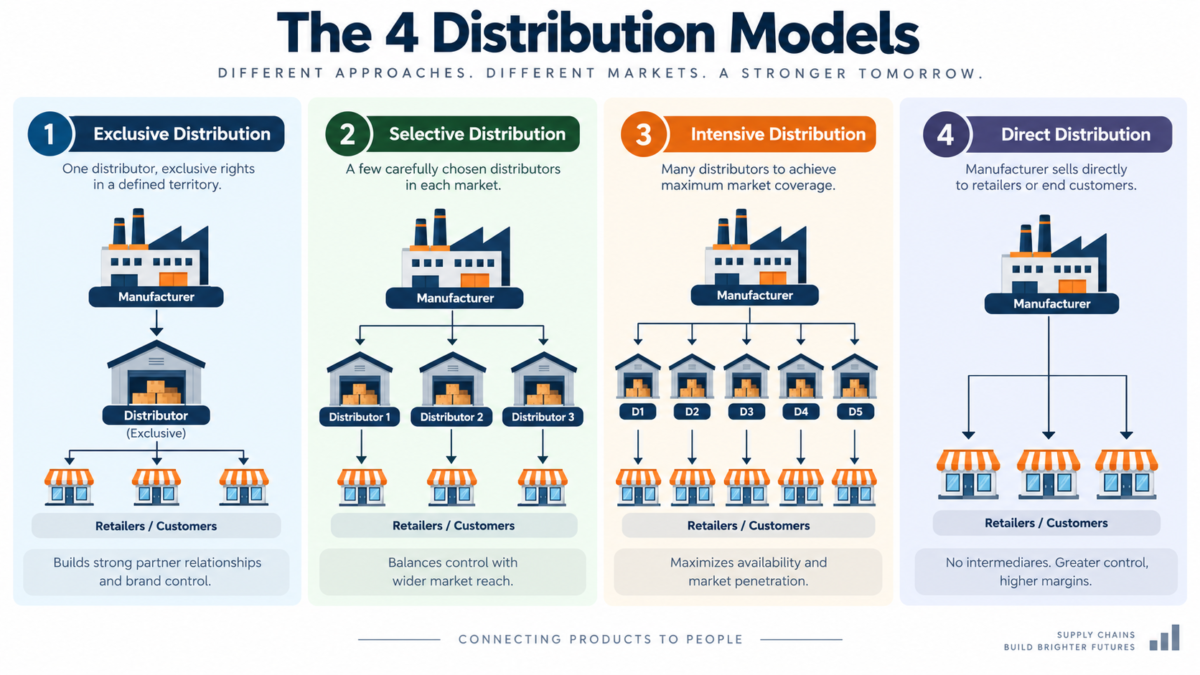
Distribution models are defined by how widely a product is made available and how many intermediaries carry it.
| Model | How many distributors | Typical products | Trade-off |
|---|---|---|---|
| Exclusive | One per territory | Luxury goods, specialist equipment, licensed brands | Tight brand control, limited reach |
| Selective | A few vetted partners | Appliances, premium beverages, cosmetics | Balance of control and coverage |
| Intensive | As many as possible | Snacks, soft drinks, batteries, everyday goods | Maximum reach, minimal control |
| Direct | None – manufacturer sells direct | D2C brands, industrial equipment, software | Full margin, full operational burden |
Exclusive Distribution
One distributor holds the rights to a product within a defined territory. Common where brand positioning matters, where the product needs specialist knowledge to sell, or where after-sales support is part of the offer. The manufacturer trades reach for control and for a partner who is properly invested in the line.
Selective Distribution
A small number of approved distributors, each meeting criteria on service level, territory coverage or facilities. This is the most common model for mid-market branded goods. It gives the manufacturer broader coverage than exclusive distribution while still filtering out partners who would damage the brand.
Intensive Distribution
Get the product into as many outlets as possible through as many distributors as will carry it. Standard for impulse and convenience goods, where the purchase decision happens at the shelf and availability is the entire strategy. Margins are thin and competition between distributors is on service and price.
Direct Distribution
The manufacturer skips distributors entirely and sells direct to retailers or end businesses. Keeps the full margin, but the manufacturer has to build the warehousing, delivery, sales and credit-control functions a distributor would otherwise provide. Most who try it underestimate that cost.
Many manufacturers run more than one model at once – exclusive in export markets, intensive domestically, direct for their largest accounts.
B2B Distribution Channels Explained
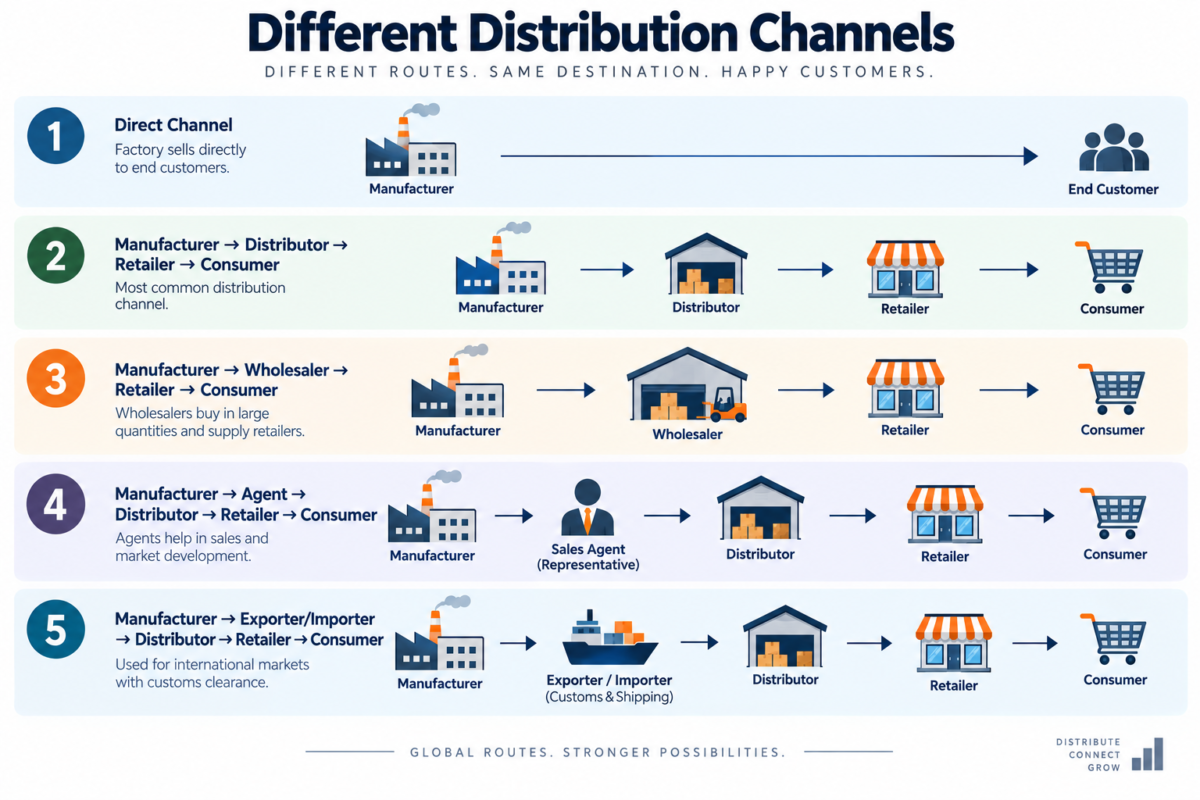
A distribution channel is the path a product travels from manufacture to end use. The common configurations:
- Manufacturer to distributor to retailer to consumer. The classic three-step chain and still the backbone of consumer goods.
- Manufacturer to wholesaler to smaller retailer. Adds a tier for markets with a very fragmented retail base.
- Manufacturer to distributor to end business. Where the buyer is the user – restaurants, salons, clinics, workshops.
- Importer to distributor to retailer. Cross-border, with the importer handling customs, compliance and currency.
- Manufacturer direct to retailer. No intermediary; typically only viable for large chain accounts.
Channel length matters because each tier takes margin and adds time. Shorter channels are cheaper and faster but demand more operational capability from the manufacturer.
B2B Distribution vs B2C Distribution
| B2B Distribution | B2C Distribution | |
|---|---|---|
| Buyer | A business buying for resale or operational use | An individual buying for personal use |
| Order size | Cases, pallets, hundreds of line items | One to a handful of items |
| Pricing | Negotiated, tiered, different per account | One public price for everyone |
| Payment | Often credit terms, Net 30 to Net 60 | Paid at checkout |
| Relationship | Ongoing, contractual, repeat by nature | Transactional, often one-off |
| Decision driver | Margin, availability, reliability | Preference, price, convenience |
| Sales cycle | Days to months, multiple stakeholders | Minutes |
| Returns | Contractual, often via credit note | Consumer-rights driven |
The practical consequence: software, processes and marketing built for B2C rarely survive contact with B2B distribution without significant adaptation.
Distributor vs Wholesaler vs Supplier vs Broker
These four terms get used interchangeably and are not the same thing.
| Role | Owns the stock? | Typical relationship with manufacturer | Adds |
|---|---|---|---|
| Distributor | Yes | Formal agreement, often territory-based | Warehousing, delivery, sales, credit, sometimes marketing support |
| Wholesaler | Yes | Usually no formal agreement; buys opportunistically | Bulk breaking and availability |
| Supplier | Sometimes | Broad term – may be the manufacturer itself | Whatever the supply agreement covers |
| Broker / agent | No | Represents the manufacturer | Introductions and negotiation; earns commission, not margin |
The most useful distinction: a distributor typically has a formal relationship with the manufacturer and provides services beyond simply holding stock. A wholesaler buys what is available and resells it. A broker never owns anything.
How Distributors Make Money: Margins and Economics
Distributors earn on the spread between buy price and sell price. Gross margins vary widely by category – low single digits in high-volume commodity lines, considerably higher in specialist or slow-moving categories where the distributor provides genuine expertise.
But gross margin is the least interesting number in distribution. Three others matter more:
Inventory turnover. How many times a year stock sells and is replaced. A distributor at low margin with high turnover can be far more profitable than one at high margin with stock sitting for months. Turnover is the real engine.
Cost to serve. Every order carries a cost – picking, packing, delivery, invoicing, and the time spent taking the order in the first place. A small order from a distant customer can be unprofitable at any gross margin. This is why minimum order quantities exist, and why manual order entry is so damaging: it inflates cost to serve on every single order.
Working capital cycle. The gap between paying the manufacturer and being paid by the buyer. A distributor paying on 30 days and collecting on 60 is financing the entire chain for a month. Growth makes this worse before it makes it better, which is why fast-growing distributors so often run into cash constraints.
Together these explain why operational efficiency matters more in distribution than in almost any other business model. On thin margins, small process improvements compound quickly.
What a Distribution Business Actually Does Day to Day
Beneath the model, a distributor runs several functions at once:
- Purchasing and demand planning – deciding what to buy and how much, against imperfect forecasts.
- Warehouse operations – receiving, putaway, picking, packing, stock counts.
- Order management – taking orders, checking credit, allocating stock, handling backorders and substitutions.
- Pricing administration – maintaining price lists, tiers, promotions and contracted rates across the customer base.
- Sales – reps covering territories, opening accounts, introducing new lines.
- Logistics – route planning, fleet or carrier management, delivery windows.
- Credit control – terms, limits, collections.
- Returns and claims – damages, short shipments, expired stock.
Most of the pain in a growing distribution business shows up in order management and pricing administration first. Both scale badly when done manually.
The Biggest Challenges in B2B Distribution Today
- Manual order entry. Orders still arrive by phone, WhatsApp and emailed spreadsheets, then get retyped into the ERP. Every retype is a chance for a wrong SKU, wrong quantity or wrong price – and each error becomes a credit note.
- Margin pressure from both ends. Manufacturers pushing for volume commitments, buyers comparing prices more easily than ever. The middle gets squeezed.
- Disintermediation. Manufacturers selling direct, and marketplaces approaching your customers. Distributors who compete only on availability are most exposed.
- Buyer expectations imported from consumer ecommerce. A buyer who orders personal goods online at 11pm now expects the same from their supplier. Order desks that close at 6pm lose orders to whoever is open.
- Inventory and working capital. Carrying enough stock to serve without tying up cash in lines that do not move.
- Rising cost to serve. Fuel, labor and delivery costs climbing faster than prices can be raised.
- Ageing systems. ERPs installed decades ago that do not connect to anything modern, forcing manual bridges between systems.
How B2B Distribution Is Being Digitised
The direction of travel is consistent across the sector: move order-taking off the phone and onto a self-service portal, and connect that portal to the ERP so nothing gets typed twice.
What that changes:
- Order entry cost drops toward zero because the buyer does the data entry.
- The order desk stops being a bottleneck and starts being an exception-handling function.
- Ordering becomes available 24/7, which captures orders placed outside business hours.
- Upsell and cross-sell become systematic rather than dependent on a rep remembering.
- Stock accuracy improves because buyers see live availability instead of ordering blind.
- Reps shift from admin to selling – opening accounts and introducing lines rather than transcribing orders.
The constraint is rarely the technology. It is data quality – product images, descriptions, pack sizes and categorisation – and buyer adoption. Both are solvable, but both take longer than the software build.
If you want the practical detail, see our guide to the B2B ecommerce platform for distributors, or the wholesale ecommerce platform page if you sell primarily to trade buyers.
B2B Distribution by Industry
Distribution works differently depending on what is in the warehouse. Case packs dominate beverage; trend speed dominates novelty; compliance dominates counter culture.
- General Merchandise Distribution – broad multi-category catalogs
- Beverage Distribution – high volume, heavy freight, case-based ordering
- Candy & Confectionery Distribution – seasonal peaks and expiry management
- Counter Culture Distribution – compliance-heavy categories
- Novelty Product Distribution – fast-moving trend cycles
- Fashion Accessories Distribution – size and style variants, seasonal ranges
Frequently Asked Questions
What is B2B distribution?
B2B distribution is the business of buying goods in bulk from manufacturers and selling them on to other businesses, mainly retailers. The distributor takes ownership of the stock, warehouses it, breaks it into smaller quantities and delivers it to buyers who cannot purchase directly from the manufacturer.
What is the difference between B2B distribution and wholesale?
They overlap heavily. A distributor usually has a formal agreement with the manufacturer, often covering a defined territory, and provides services such as delivery, sales support and marketing. A wholesaler typically buys available stock opportunistically and resells it without a formal manufacturer relationship.
What are the four types of distribution?
Exclusive distribution (one partner per territory), selective distribution (a few vetted partners), intensive distribution (as many outlets as possible) and direct distribution (the manufacturer sells without an intermediary).
How do B2B distributors make money?
On the margin between buying price and selling price. Because gross margins are often thin, profitability depends more on inventory turnover, cost to serve per order, and the working capital cycle than on the headline margin.
What is a distribution channel?
The path a product takes from manufacture to end use. A common B2B channel runs manufacturer to distributor to retailer to consumer, though channels can be shorter or include additional wholesale tiers.
Is B2B distribution profitable?
It can be, but it is a volume and efficiency business rather than a high-margin one. Profitability is driven by stock turnover, keeping cost per order low, and managing the gap between paying suppliers and being paid by customers.
What is the difference between a distributor and a supplier?
“Supplier” is a broad term for anyone who supplies goods, including manufacturers. “Distributor” is specific: an intermediary who buys from manufacturers, holds stock and sells on to business buyers.
Do distributors take ownership of inventory?
Yes. This is what separates a distributor from a broker or agent. The distributor buys the stock, carries it on the balance sheet and bears the risk if it does not sell. A broker arranges the sale without ever owning the goods.
What challenges do B2B distributors face?
Manual order entry, margin pressure from manufacturers and buyers, manufacturers selling direct, buyer expectations shaped by consumer ecommerce, working capital tied up in stock, rising cost to serve, and ageing systems that do not integrate.
How is B2B distribution changing?
The main shift is from phone and email ordering to self-service online portals connected to the ERP, which removes duplicate data entry, makes ordering available around the clock and frees sales reps from administrative work.
What is cost to serve in distribution?
The full cost of fulfilling an order – taking it, picking, packing, delivering and invoicing. A small order from a distant customer can be unprofitable regardless of gross margin, which is why minimum order quantities and efficient order capture matter so much.
Who buys from B2B distributors?
Retailers of all sizes, convenience stores, restaurants and foodservice operators, contractors, salons, clinics, institutions such as schools and hospitals, and other distributors.
Key Terms Glossary
Break bulk – splitting large manufacturer shipments into smaller quantities for individual buyers.
Case pack – the number of units in a standard selling case; usually the minimum orderable quantity.
Cost to serve – the total cost of fulfilling a single order, end to end.
Disintermediation – a manufacturer bypassing distributors to sell direct.
Fill rate – the percentage of ordered items shipped complete and on time.
Inventory turnover – how many times stock sells and is replaced in a year.
MOQ (minimum order quantity) – the smallest order a distributor will accept.
Net terms – payment after delivery, commonly Net 30 or Net 60.
SKU (stock keeping unit) – a unique code identifying one distinct product variant.
Working capital cycle – the gap between paying suppliers and collecting from customers.
If you are running a distribution business and the order desk has become the bottleneck, that is usually the first thing worth fixing. We build B2B ordering platforms for distributors and can show you what it looks like on your own catalog.
 Get Started