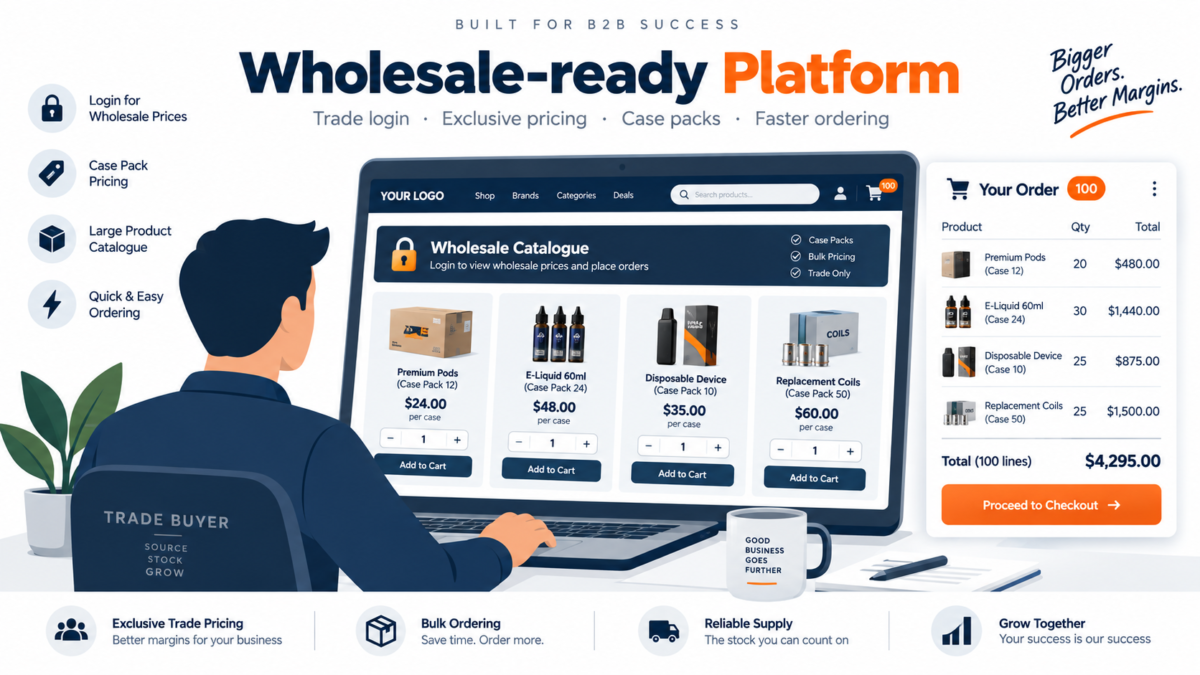
A wholesale ecommerce platform is online store software built for selling in bulk to trade buyers rather than single units to consumers. The defining requirements are tiered pricing that changes with quantity, minimum order quantities, net payment terms, and a login wall so your trade prices never appear publicly.
Key facts at a glance
- Who it is for: wholesalers, importers, brand owners selling to trade, and distributors with a wholesale arm.
- Non-negotiable features: tiered pricing, MOQs, net terms, bulk ordering, private catalogue.
- Most common mistake: bolting wholesale plugins onto a retail platform and discovering the pricing engine cannot cope.
- Typical launch: 4-8 weeks.
- The real test: load your actual price list and see whether the platform can express it without workarounds.
What Makes a Platform “Wholesale-Ready”?
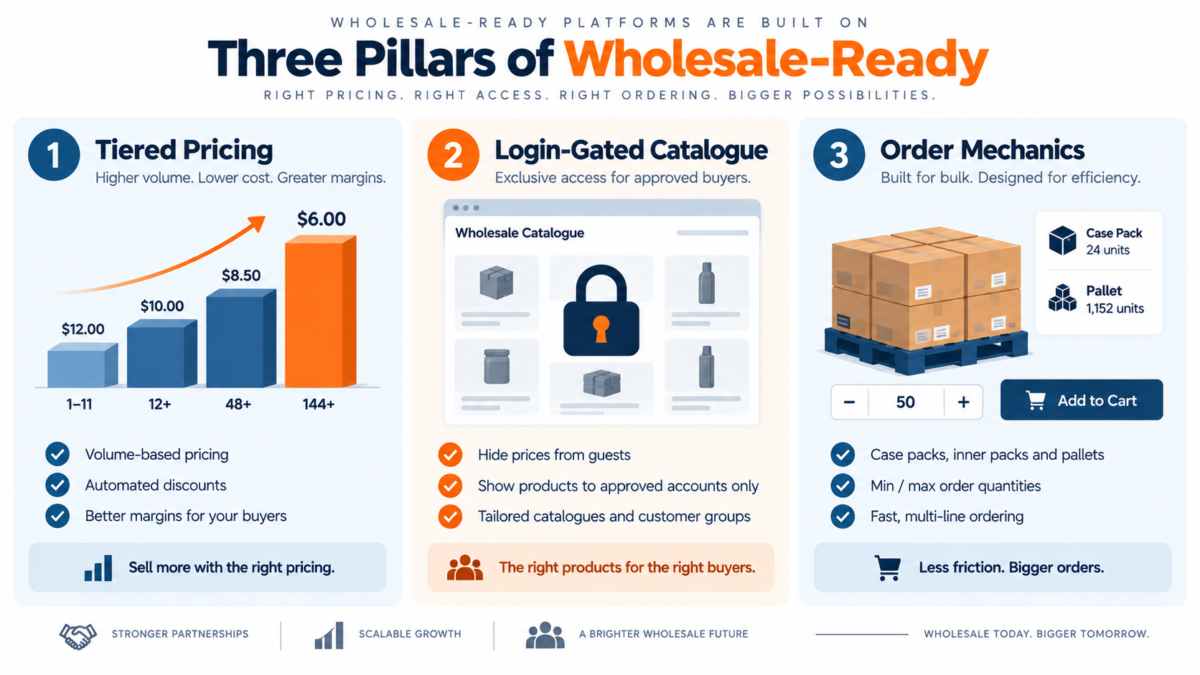
Three things, and a platform missing any one of them will cost you more in workarounds than it saves in licence fees.
A pricing engine that thinks in tiers. Wholesale prices move with quantity. Twelve units is one price, a hundred is another, a pallet is another. The platform must express this as a rule, not as a separate product variant for every quantity band.
A login wall. Trade prices must not be visible to the public, to your retail customers, or to competitors browsing your site. Wholesale-ready means the catalogue is gated by default and opened per approved account.
Order mechanics built for volume. Minimum order quantities, case-pack enforcement, bulk entry by SKU code, and the ability to place a hundred-line order without a hundred clicks.
Everything else – recommendations, badges, abandoned cart recovery – is upside. These three are the floor.
Why Retail Platforms Break at Wholesale Scale
Most wholesalers start by extending a retail store with plugins. It works until it doesn’t, usually at one of these five points.
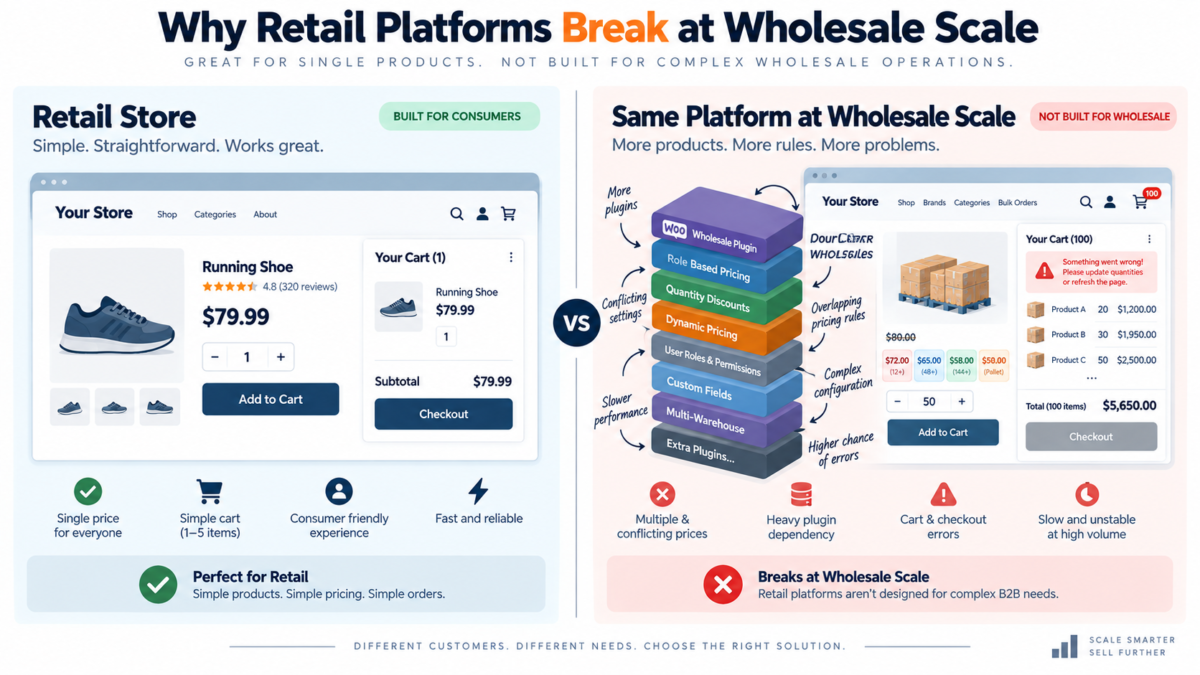
| What wholesale needs | What a retail platform does | Where it breaks |
|---|---|---|
| Different price per customer | One public price per product | Plugins bolt on a second pricing layer that conflicts with promotions and tax |
| Quantity price breaks | Fixed price, maybe a bulk discount coupon | Coupon logic cannot express real case-break structures |
| Minimum order quantities | Sells one unit happily | MOQ plugins fail at cart level, letting under-MOQ orders through |
| Net 30 terms and credit limits | Pay now, at checkout | Requires custom development; credit limits go unenforced |
| 100+ line orders | Cart built for a handful of items | Checkout slows or times out; buyers abandon |
None of these are individually fatal. Together they produce a store your sales team quietly stops trusting, and orders drift back to email and phone.
Wholesale Features That Actually Matter
Ranked by how often their absence kills a wholesale ecommerce project.
| Rank | Feature | What happens without it |
|---|---|---|
| 1 | Tiered / quantity-break pricing | Your price list cannot be represented at all |
| 2 | Customer-group and account-specific pricing | Negotiated rates get managed by hand, off-platform |
| 3 | Login-gated catalogue | Trade prices leak publicly |
| 4 | Minimum order quantity enforcement | Uneconomic small orders you have to phone up and correct |
| 5 | Bulk order by SKU code | Experienced buyers refuse to use the store |
| 6 | Net terms and credit limits | Your best accounts cannot buy the way they always have |
| 7 | Repeat order | Reorder frequency stays flat; the store adds no convenience |
| 8 | Real-time stock sync | Overselling, then credit notes, then lost trust |
| 9 | Request a quote | Negotiated lines have nowhere to live |
| 10 | Backorder and pre-order | Stockouts become lost sales rather than delayed ones |
BB2B covers all ten. The point of the ranking is that you should apply it to every vendor you evaluate, not only to us.
Wholesale-Only vs Mixed B2B/B2C Selling
Two different situations, two different builds.
Wholesale only. The entire site sits behind a login. Simpler to run, and the right answer if you have no direct-to-consumer business.
Mixed B2B and B2C. You sell retail publicly and wholesale privately. This needs careful separation: distinct customer groups, distinct pricing layers, and absolute certainty that trade prices never render for a retail visitor. It is achievable, but it is a build decision to make at the start, not a setting to flip later.
The failure case to avoid is running two disconnected stores on one inventory pool. Stock gets sold twice and neither store’s numbers are trustworthy.
Moving From Manual Wholesale Ordering to Online
- Clean the price list first. Every workaround in your current spreadsheet becomes a configuration problem later. Resolve conflicts before the build.
- Map your customer groups. Most wholesalers discover they have fewer real pricing tiers than they thought – often five or six, not fifty.
- Sort product data. Images, descriptions, pack sizes, case quantities. This is the longest task in almost every project.
- Import accounts, don’t ask buyers to register. Signup friction is the most common cause of low adoption.
- Connect the ERP before launch, not after.
- Launch to your top 20 accounts first. Fix what they trip over, then roll out to everyone.
- Have reps place the first order with each buyer. Adoption is a human process; the software is the easy half.
Wholesale Ecommerce for Your Category
- General Merchandise Distribution
- Beverage Distribution
- Candy & Confectionery Distribution
- Counter Culture Distribution
- Novelty Product Distribution
- Fashion Accessories Distribution
Comparing vendors? Our guide to choosing a wholesale ecommerce platform covers evaluation criteria, vendor questions and red flags in detail.
Selling primarily as a distributor rather than a wholesaler? See our B2B ecommerce platform for distributors.
Frequently Asked Questions
What is a wholesale ecommerce platform?
Online store software built for selling in bulk to trade buyers. It handles tiered pricing that changes with quantity, minimum order quantities, net payment terms and login-gated catalogues, none of which standard retail ecommerce platforms support natively.
Can I use Shopify or WooCommerce for wholesale?
Both can be extended with wholesale plugins and work for simple cases. They strain when pricing gets complex – multiple overlapping tiers, per-account negotiated rates, case-break structures – because the underlying pricing model assumes one public price per product.
What is the difference between wholesale and B2B ecommerce?
Wholesale is a type of B2B. Wholesale specifically means selling goods in bulk for resale. B2B ecommerce is the broader category and also covers services, manufacturing supply and procurement, which have different requirements.
How do I stop customers seeing each other’s prices?
Account-level pricing tied to a login. Each buyer sees only the price list assigned to their account or customer group, and no pricing is visible before login.
Can I set minimum order quantities?
Yes, at product, category or customer-group level, enforced in the cart rather than flagged after the order is placed.
Do wholesale platforms support net payment terms?
Yes. Conditional payment options let approved accounts order on Net 30 or Net 60 within a set credit limit, alongside card and offline payment for other accounts.
How do I handle wholesale and retail on the same site?
Through separate customer groups with separate pricing layers and visibility rules on one platform and one inventory pool. Build it as a mixed model from the start rather than retrofitting a retail store.
How long does a wholesale ecommerce build take?
Typically 4-8 weeks. Product data preparation and pricing rule complexity drive the timeline far more than the platform build itself.
How many customers can a wholesale platform handle?
Thousands, provided pricing is rule-based rather than per-account manual entry. The constraint is how pricing is modelled, not the customer count.
What does wholesale ecommerce cost?
It depends on catalogue size, pricing complexity and ERP integration scope. Measure it against order-entry hours removed and orders captured outside business hours rather than against licence fee alone.
See It Running on Your Price List
The only demo worth watching is one using your products, your tiers and your minimum order quantities. Send us your price list and we will build the demo around it.
 Get Started