Delivering Seamless Engagement Across Every Touchpoint
Customer expectations have changed dramatically in today’s digitally driven business environment. B2B purchasers increasingly expect smooth, dependable, and customized interactions through a variety of channels. The B2B omnichannel experience is becoming a crucial part of contemporary corporate strategy due to this change.
Businesses that place a high priority on a robust B2B omnichannel experience are better able to engage clients, optimize processes, and promote long-term success. Businesses can create a coherent journey that improves customer happiness and operational efficiency by combining several communication and sales channels into a single system.
Understanding the B2B Omnichannel Experience
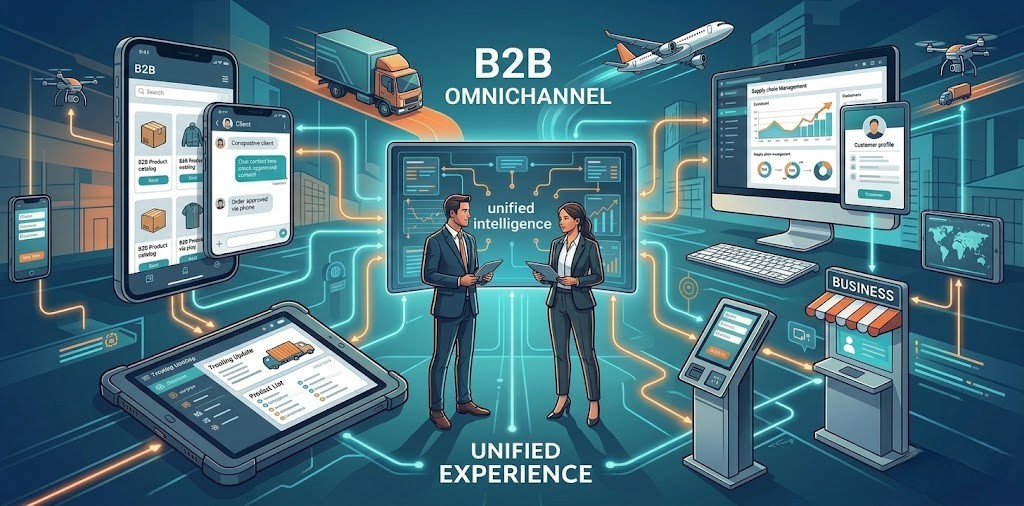
The integration of several customer engagement channels, including websites, mobile applications, email, sales teams, and customer support, into a smooth and cohesive experience is known as the B2B omnichannel experience. The B2B omnichannel experience guarantees that all channels are integrated and function as a unit, in contrast to multichannel strategies, which function in silos.
Customers can easily switch between channels using this method without losing context or continuity. Businesses must align their teams, systems, and procedures to provide consistent message and service in order to implement a great B2B omnichannel experience.
Importance of the B2B Omnichannel Experience
1. Increased Client Contentment
A smooth travel experience raises client happiness. Customers are guaranteed consistent and pertinent interactions across all touchpoints thanks to the B2B omnichannel experience.
2. Enhanced Involvement
Relationships are strengthened when consumers are engaged through a variety of channels. Businesses can connect with customers wherever they are thanks to the B2B omnichannel experience.
3. Increased Rates of Conversion
The purchasing process is less complicated with a well-integrated strategy. The B2B omnichannel experience assists clients in making wise choices.
4. Enhanced Brand Uniformity
Establishing trust requires consistency. The B2B omnichannel experience guarantees consistent branding and messaging across all platforms.
Key Components of a Successful B2B Omnichannel Experience
1. Consolidated Customer Information
Providing a consistent experience requires centralized data. Accurate and easily available customer data is essential to the B2B omnichannel experience.
2. Systems of Integrated Technology
Smooth communication between channels is ensured via technology integration. The B2B omnichannel experience is supported by a strong infrastructure.
3. Customized Communications
Engagement is increased via personalization. Data is used in the B2B omnichannel experience to customize interactions according to client preferences.
4. Regular Communication
It’s critical to keep your voice consistent across all platforms. Customers are guaranteed to receive coherent and clear communication thanks to the B2B omnichannel experience.
Strategies to Implement B2B Omnichannel Experience
1. Create a customer journey map
The B2B omnichannel experience is built on an understanding of the customer journey. All interactions and touchpoints must be identified by businesses.
2. Make a Technology Investment
The B2B omnichannel experience requires sophisticated platforms and technologies.
3. Align Procedures and Teams
Departmental cooperation guarantees uniformity. Alignment between the sales, marketing, and support teams is necessary for the B2B omnichannel experience.
4. Make Use of Analytics
Optimizing the B2B omnichannel experience requires data-driven insights.
5. Put Continuous Improvement First
Over time, customer expectations change. Maintaining a successful B2B omnichannel experience requires regular changes.
Role of Technology in B2B Omnichannel Experience
1. Systems for Customer Relationship Management (CRM)
CRM systems support the B2B omnichannel experience by offering a unified view of customer interactions.
2. Tools for Marketing Automation
Automation improves the B2B omnichannel experience by facilitating timely and pertinent communication.
3. AI, or artificial intelligence
AI-powered solutions enhance the B2B omnichannel experience’s predictive and personalized features.
4. Platforms for Analytics
Analytics technologies aid in performance evaluation and B2B omnichannel experience optimization.
Challenges in Delivering B2B Omnichannel Experience
1. Silos of Data
Integration may be hampered by disconnected systems. The B2B omnichannel experience depends on breaking down data silos.
2. Complicated Purchasing Processes
B2B purchasing procedures are frequently intricate. One of the main challenges in the B2B omnichannel experience is managing these complications.
3. Limitations on Resources
The B2B omnichannel experience may be impacted by the substantial investment needed to implement advanced technologies.
4. Sustaining Uniformity
The B2B omnichannel experience depends on maintaining consistent message across channels.
Measuring the Success of B2B Omnichannel Experience
Businesses should monitor key performance indicators in order to assess the efficacy of the B2B omnichannel experience:
- Levels of customer engagement
- Rates of conversion
- Customer retention rates
- Duration of the sales cycle
- Scores for customer satisfaction
These measurements shed light on how business performance is affected by the B2B omnichannel experience.
Best Practices for B2B Omnichannel Experience
1. Give the needs of the customer priority.
Delivering a great B2B omnichannel experience requires an understanding of customer expectations.
2. Assure Smooth Integration
For the B2B omnichannel experience to be supported, technology and procedures must cooperate.
3. Educate Workers
When it comes to providing the B2B omnichannel experience, employees are essential.
4. Keep an eye on and improve
The effectiveness of the B2B omnichannel experience is maintained through ongoing monitoring.
Future Trends in B2B Omnichannel Experience
1. Excessive Customization
Highly customized interactions inside the B2B omnichannel experience will be made possible by advanced data analytics.
2. Engagement in Real Time
In order to improve the B2B omnichannel experience, businesses will put more emphasis on real-time communication.
3. AI-Powered Perspectives
Optimizing the B2B omnichannel experience will be greatly aided by AI.
4. Combined Ecosystems
Delivering the B2B omnichannel experience will require seamless platform connection.
Conclusion
Providing a smooth and consistent client experience is crucial for success in a B2B market that is becoming more and more competitive. Businesses may successfully engage customers, optimize operations, and promote sustainable growth with the help of the B2B omnichannel experience.
Organizations may develop a cohesive experience that improves customer satisfaction and fosters long-term connections by utilizing data, integrating technology, and concentrating on client demands. Although there are difficulties, the advantages of the B2B omnichannel experience greatly exceed these difficulties.
Companies who invest in the B2B omnichannel experience now will be in a better position to succeed in the long run, stay competitive, and adjust to emerging trends.




 Get Started