
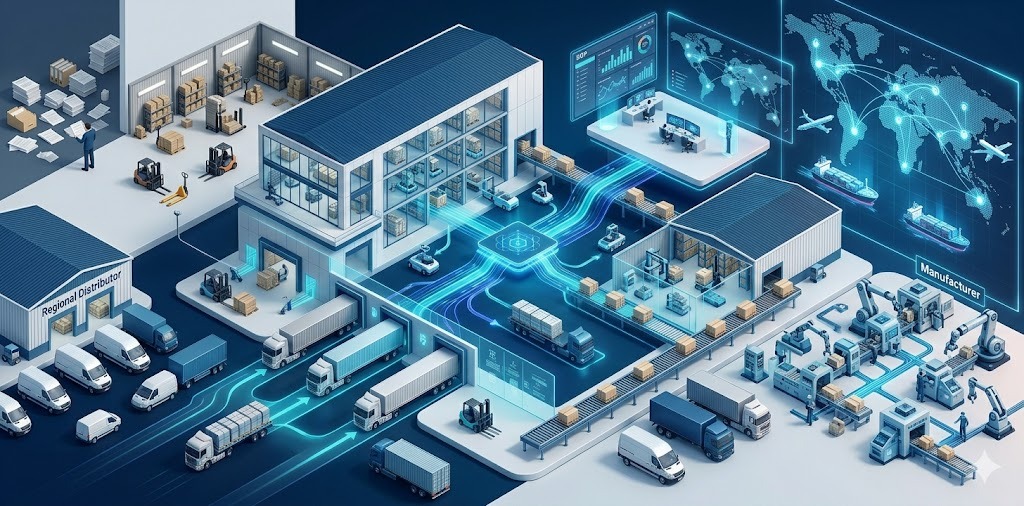
There is a number that stops most people the first time they hear it. The global B2B ecommerce market is not just larger than its consumer counterpart — it is six times larger. According to data from Statista and leading industry research firms, the B2B digital commerce space has crossed $7.7 trillion in annual transaction value, while B2C ecommerce sits at roughly $1.3 trillion globally. That is not a small gap. That is a chasm. And yet, walk into the back office of a wholesaler or distributor today and you will still find spreadsheets, phone orders, fax confirmations, and sales reps manually keying in purchase orders that could have been processed automatically while they slept.
The question is not whether digital commerce is the future of wholesale and distribution. It already is the present. The real question is whether your distribution business is positioned to capture its share of that $7.7 trillion opportunity — or whether you are quietly handing revenue to competitors who recognized the shift earlier and acted on it. Every month that passes with your buyers still calling in orders is a month of data you are not collecting, efficiency you are not gaining, and loyalty you are not building.
This guide is written specifically for wholesalers and distributors who are either considering a move to digital commerce or who have already started but are not yet seeing the returns they expected. We will break down why this market is the size it is, what is driving its extraordinary growth, where most distributors go wrong in their digital transition, and most importantly, what you need to do right now to build a B2B ecommerce operation that delivers real, measurable results for your business and your buyers.
Why Is the B2B Ecommerce Market So Much Larger Than B2C?
The size difference between B2B and B2C digital commerce is not accidental — it is deeply structural. When a consumer buys a pair of shoes online, that transaction is typically worth between $50 and $300. When a regional distributor places a replenishment order with a wholesale supplier, that single transaction can be worth tens of thousands of dollars. Now multiply that by hundreds of active buyer accounts, each ordering weekly or monthly on established schedules, and you begin to see how transaction volumes stack up in ways consumer retail simply cannot match.
There are three core structural reasons why B2B ecommerce dwarfs the consumer space, and understanding them is important because they directly shape what your digital infrastructure needs to look like.
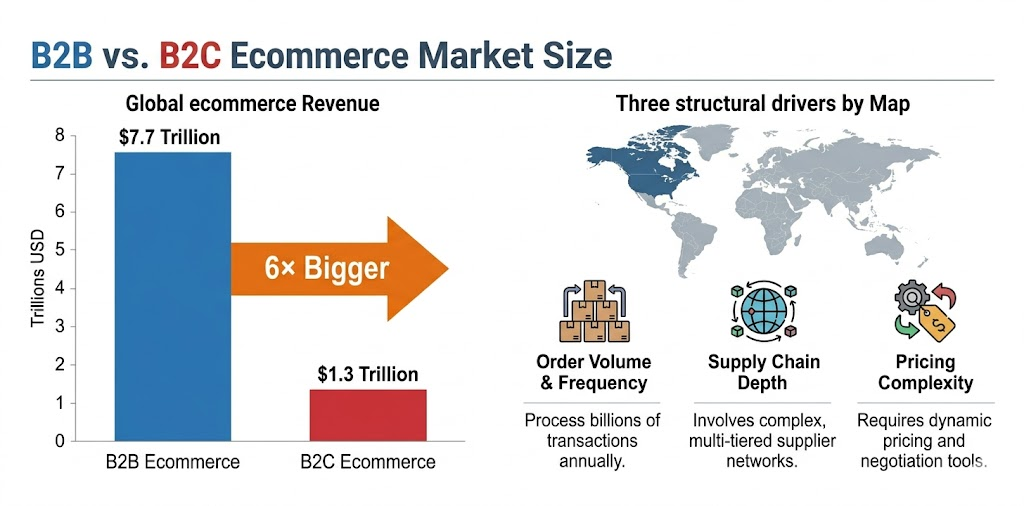
The first reason is order frequency and volume. Business buyers do not browse — they replenish. A retail chain restocking 40 SKUs every two weeks, a restaurant group reordering from a food distributor on a weekly basis, an industrial equipment supplier fulfilling standing contracts with manufacturers across a region — these are recurring, high-value transactions that happen with regularity and predictability. Consumer ecommerce is built for discovery and impulse. B2B buying is built around reliability and efficiency. The platforms that serve distributors well are the ones designed around that fundamental difference in buyer behavior.
The second reason is supply chain depth. In B2B, a single product passes through multiple commercial hands before it ever reaches an end consumer — from manufacturer to national distributor to regional wholesaler to retailer. Every single handoff in that chain is a commercial transaction, and increasingly, those transactions are happening online rather than through phone calls, paper purchase orders, or rep visits. The progressive digitization of the supply chain is one of the most powerful engines driving the continued expansion of this market, and it is far from complete.
The third reason is pricing complexity. In consumer retail, everyone pays the same price — or close to it. In wholesale and distribution, that is almost never true. Tiered pricing based on volume, contract pricing for key accounts, buyer-specific catalogs that exclude certain product categories, credit terms that vary by account history — all of this means the digital infrastructure required to serve B2B buyers is far more sophisticated than a standard checkout page. This complexity is also exactly what kept many distributors on manual processes for so long. Building it used to require enormous custom IT investment. Today, purpose-built B2B ecommerce platforms make that same capability accessible for mid-market distributors without a large technology team.
The Buyer Shift That Changed Everything
To understand the urgency distributors face today, you need to understand how dramatically buyer behavior has changed over the past five years. The pandemic compressed what might have been a decade of gradual digital adoption into roughly eighteen months. When in-person sales visits became impossible and trade shows went entirely dark, buyers who had spent years relying on phone calls and rep relationships discovered that placing orders online was not just an acceptable substitute — it was often preferable. Orders placed at 9pm. Instant confirmation. No waiting for a callback. No back-and-forth on availability.
Research from McKinsey found that more than 70% of B2B buyers now prefer self-service digital interactions over traditional sales contact for routine orders, even for orders of significant size and complexity. That preference did not disappear when the world reopened. It solidified into an expectation.
There is a generational dimension to this shift that distributors cannot afford to ignore. Millennial and Gen Z professionals now make up a rapidly growing portion of business purchasing decision-makers across industries. These buyers have grown up with consumer ecommerce. They have been ordering everything from groceries to furniture online since their teens. When they step into a procurement or purchasing role, they carry those expectations with them. They expect search that actually works. They expect transparent pricing without a phone call. They expect to see their order history and track a shipment without contacting anyone. They expect a mobile experience that works as well as the desktop. And if your buying process does not meet those expectations, they notice — and they remember.
For wholesalers and distributors, this creates both a significant risk and a genuine competitive opportunity. The risk is that if your buyers can find a supplier with a more capable digital ordering experience, they will migrate toward it, even when your pricing is competitive and your product range is strong. Buyer loyalty in distribution has historically been sticky, but it is not unconditional. The opportunity is equally clear: the distributors who build superior digital buying experiences now will create a layer of loyalty that is genuinely difficult for competitors to displace. When a buyer’s entire order history, their custom pricing, their preferred delivery addresses, and their repeat-order templates all live in your platform, switching has a real cost. That is a powerful retention mechanism — but only if the experience is good enough that buyers want to stay.
Friction does not create loyalty. Friction creates resentment. Slow order confirmations, unclear pricing, the need to call a rep to check availability, manual processes that delay fulfillment — none of these bind buyers to you. They push buyers toward whoever makes it easier.
What Wholesalers and Distributors Are Actually Getting Wrong?
There is a pattern that plays out repeatedly among distributors who attempt a digital transition and find themselves underwhelmed by the results twelve months later. They invest in a platform, launch a product catalog, send an email announcement to their buyer base, and then wait for digital orders to flow in — only to find that most of their buyers are still calling the same sales reps they always called, doing business exactly as they did before.
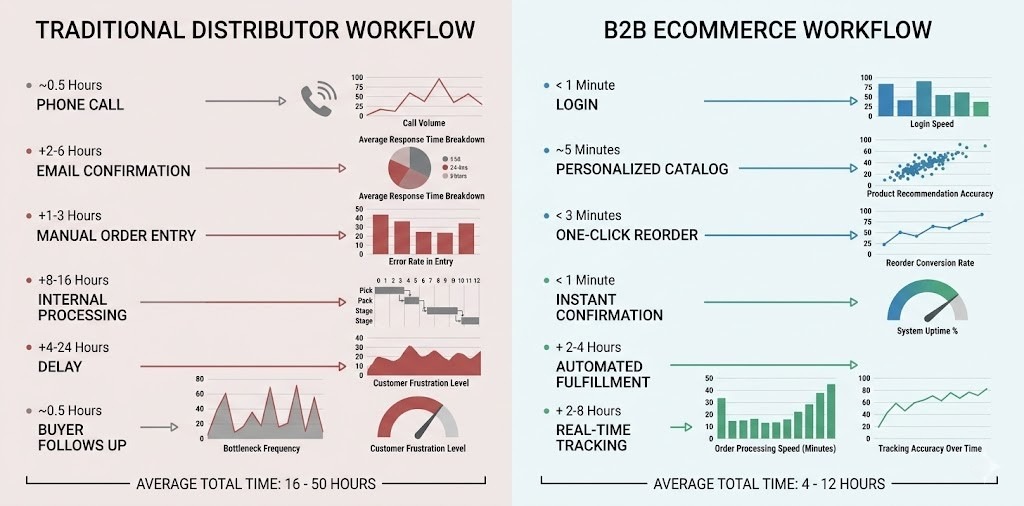
The problem, in almost every case, is not the technology. It is the strategy surrounding the technology. Here are the most common and most costly mistakes that prevent a true B2B ecommerce operation from delivering the results it should.
The first mistake is treating the portal as a catalog rather than a commerce engine. A product listing page is not digital commerce. Real B2B buying means that when a buyer logs in, they see their specific contract pricing, their credit terms, their approved product list, their full order history, their open orders and pending shipments — all in a single authenticated, personalized experience that reflects the actual commercial relationship between that buyer and your business. Distributors who launch a generic storefront without account-specific logic are not offering B2B ecommerce — they are offering a brochure with a checkout button.
The second mistake is neglecting the reorder workflow. The single highest-value behavior in distribution is the repeat order. A buyer who orders the same 30 SKUs every two weeks should be able to complete that transaction in under 60 seconds. One click to pull up their last order, review it, make minor adjustments, and confirm. Standing order templates that they can modify without rebuilding from scratch. If your platform requires buyers to search for and add every item individually each time they order, you have not reduced friction — you have simply moved it from the phone to the screen.
The third mistake is underinvesting in buyer onboarding. Activating a wholesale account on a digital platform is fundamentally different from a consumer signing up for an online store. There are credit applications, approved product lists specific to the buyer’s account type, custom pricing agreements, and often multiple delivery addresses across different locations. Distributors who simply send buyers a login link and expect them to figure it out find that adoption stalls at 20 or 30 percent of the buyer base. The buyers who do not activate are not technology-resistant — they were just never properly brought across.
The fourth mistake is running the platform as a silo. A digital ordering portal that is not connected to your ERP, your inventory management system, and your warehouse operations creates more administrative work, not less. Orders placed online that then need to be manually re-entered into fulfillment systems, inventory data that is static rather than real-time, pricing that lives in a spreadsheet rather than being pulled dynamically from your systems — these gaps destroy the efficiency case for going digital and create a worse buyer experience than the phone order process they were meant to replace.
The Real Opportunity: Self-Service That Multiplies Your Sales Team
Here is the insight that changes how most distribution leaders think about going digital: a well-built B2B ecommerce platform does not replace your sales team. It multiplies what your sales team can accomplish.
When buyers are managing their own routine reorders digitally — the predictable, recurring transactions that make up the bulk of order volume — your sales reps are no longer order takers. They become account developers. They are free to spend their time growing existing accounts, identifying upsell opportunities, handling exceptions and complex requirements, building genuine commercial relationships, and opening new accounts. The distributors who see the highest return from their digital investment are those who deliberately reposition their sales team around this new reality from day one rather than waiting for it to happen organically.
The arithmetic is hard to argue with. A sales rep who spends four hours per day on order entry, order follow-up, and status calls — a very conservative estimate in most distribution businesses — gains sixteen hours per week when a digital platform absorbs that work. Across a team of ten reps, that is 160 hours per week redirected toward revenue-generating activity. The platform pays for itself many times over before you count a single incremental order from digital convenience.
Beyond the efficiency case, the data generated by a digital commerce operation is itself one of the most underappreciated assets in distribution. When orders are placed digitally, you gain visibility that simply does not exist in a phone-and-spreadsheet business. You can see which buyers are ordering with declining frequency — a churn signal that gives you time to intervene before the account goes quiet. You can see which product categories are gaining share of wallet within an account — an upsell conversation waiting to happen. You can see which SKUs have strong browsing behavior but low conversion — a signal that pricing, product information, or minimum order quantities need attention. You can identify which buyer accounts have never activated on the platform — an onboarding priority that your sales team can address with a targeted conversation. Every one of these insights drives decisions that compound over time into a meaningfully stronger, more predictable, and more profitable distribution business.
What a High-Performing Digital Distribution Operation Looks Like?
Getting concrete about what good looks like is important, because the gap between a functional portal and a truly high-performing digital distribution operation is wider than most distributors expect.
Account-specific pricing and catalogs are the non-negotiable foundation. Every buyer who logs in sees their negotiated prices, their approved product range, and their account terms reflected accurately and in real time. There is no confusion about what they can order, no need to call a rep to confirm that a price is correct, and no risk of a buyer ordering something that falls outside their agreement and creating a downstream problem.
Frictionless reordering is what turns a portal into a productivity tool. One-click reordering from previous orders. Standing order templates that buyers can save, modify, and resubmit in seconds. Order guides organized the way buyers think about their purchasing, not the way your internal catalog is structured. Minimum order quantity logic and delivery schedule information built in so buyers are not surprised during checkout.
Real-time inventory visibility removes one of the biggest sources of post-order friction in distribution. When buyers can see current stock levels before placing an order, the volume of calls and emails generated by unavailable items drops dramatically. Automatic backorder notifications, lead time information, and substitution suggestions when a preferred item is out of stock all contribute to a buyer experience that feels reliable and professional.
Seamless integration between the ordering platform and your back-end operations is what makes the entire model economically viable. Orders placed digitally should flow automatically into your warehouse management system, generating pick lists and shipping instructions without anyone touching a keyboard. Tracking information should come back to the buyer portal automatically so buyers never need to call for a status update. Inventory data should be live, not updated on a batch schedule. This level of integration is what separates a genuine B2B ecommerce operation from a website with a shopping cart.
The Competitive Landscape Is Narrowing Faster Than You Think
The window for building meaningful first-mover advantage in digital distribution is still open, but it is not wide open for much longer. In most B2B categories, the majority of distributor transactions are still processed through manual or semi-digital channels. That gap represents an opportunity — but it is closing with each passing year as more distributors make the move and more buyers raise their baseline expectations.
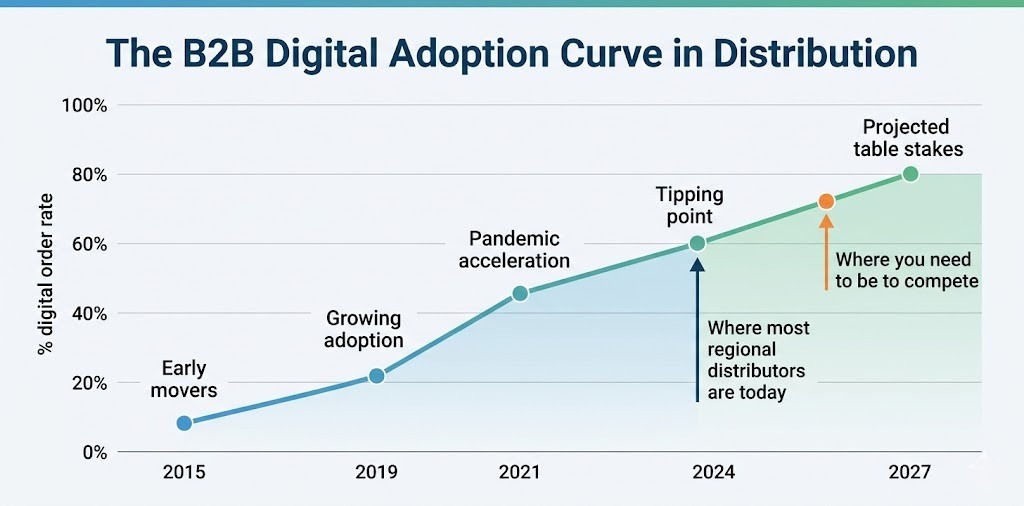
Amazon Business is the competitor that focuses the mind most sharply. It processed over $35 billion in B2B sales in 2023 and continues to expand aggressively into wholesale categories that were previously the exclusive territory of specialist distributors. Its advantages are obvious — selection, pricing transparency, fast delivery, and a buying experience that buyers already know from their personal lives. But its disadvantages are equally real: it cannot offer account-specific pricing, it cannot extend credit terms, it has no relationship with the buyer, and it has no knowledge of the buyer’s specific business needs. A regional distributor with a well-built digital platform and strong buyer relationships can compete with Amazon Business effectively — but only if the digital experience is genuinely good.
The distributors who are winning this competitive moment are not the largest ones. They are the most digitally capable ones. A mid-market wholesaler with a modern B2B ecommerce platform, clean and accurate inventory data, personalized buyer experiences, and fast, reliable fulfillment consistently outperforms larger competitors still running manual order processes. Digital capability has become the primary differentiator in distribution, and it will shortly become the baseline requirement for remaining competitive at all.
A Practical Four-Phase Roadmap for Distributors
If you are reading this as a wholesaler or distributor who knows the move to digital is necessary but feels uncertain about where to begin, the following framework gives you a clear path from where you are to where you need to be. This is not a theoretical model — it reflects the sequencing that consistently produces the strongest outcomes for distribution businesses making this transition.
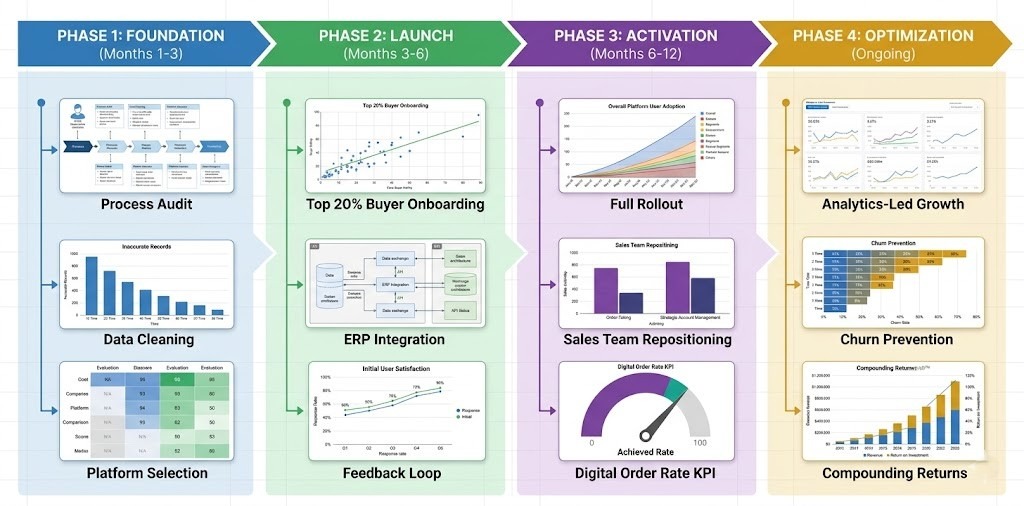
Phase 1 is Foundation, and it covers the first three months. Before selecting a platform or writing a single line of technical requirements, audit your current order process end-to-end with fresh eyes. Map every single touchpoint where buyers interact with your business. Identify every source of friction — for buyers and for your own team. Document your pricing logic fully, including all the edge cases and exceptions that currently live only in your most experienced rep’s head. Clean your product data. Resolve the inconsistencies in your buyer account records. This groundwork phase feels slow, but the distributors who skip it are the ones who find themselves rebuilding their platform eighteen months after launch.
Phase 2 is Launch, and it runs from months three through six. Do not launch to your entire buyer base on day one. Start with your top 20% of accounts by revenue — the buyers who represent the highest value and who are most likely to be early adopters. Onboard each of these accounts personally. Assign someone to walk them through the platform, answer their questions, and make sure their pricing, catalogs, and account settings are exactly right. Collect structured feedback after the first 30 days. Use it to refine the experience before the broader rollout. Most critically: integrate the platform with your ERP and warehouse systems before the first order is placed, not after.
Phase 3 is Activation, running from months six through twelve. Roll the platform out to your full buyer base with an intentional onboarding plan for each segment. Retrain your sales team — not on the technology, but on their new role. They are no longer order processors. They are account developers who use platform data to have better, more informed conversations with buyers. Build automated workflows: low-stock alerts, reorder reminders for buyers who have gone quiet, order confirmation and tracking notifications, and account review summaries for your sales team. Begin tracking digital order rate — the percentage of total orders placed digitally — as a primary operational KPI.
Phase 4 is Optimization, and it is ongoing. At this stage, the platform is generating a continuous stream of data about buyer behavior, product performance, and account health. Use it. Build a regular cadence of reviewing which accounts are not yet digitally active and prioritizing outreach. Identify SKUs with high view rates but low conversion and investigate whether pricing, product information, or availability is the barrier. Monitor order frequency trends by account and flag declining patterns for sales follow-up before they become churn. The distributors who treat their digital platform as a living system rather than a one-time deployment are the ones who see compounding returns year over year.
The Bottom Line
The $7.7 trillion figure is not a projection about where the market is heading. It is where the market already is. B2B ecommerce is the dominant commercial channel globally for wholesale and distribution transactions, and the gap between businesses that have built genuine digital capability and those still running on manual processes is growing every quarter.
The barriers that once made digital transformation feel out of reach for mid-market distributors — cost, technical complexity, integration requirements — have largely been removed. Purpose-built platforms designed specifically for wholesale and distribution use cases now exist at price points that make the investment decision straightforward once you model the efficiency gains realistically. The technology is no longer the obstacle. Strategy and execution are.
Your buyers are already expecting a digital buying experience. The expectations they bring from consumer ecommerce do not disappear when they sit down at a purchasing desk. Your competitors — including the largest and most well-resourced ones — are already building the digital infrastructure to serve those expectations. And the market, sitting at $7.7 trillion and growing, does not pause for businesses that are still deciding.
The distributors who act now get to define what excellent looks like in their market. They get to be the supplier their buyers benchmark everyone else against. The ones who wait will spend the next several years catching up to a standard someone else set — and in distribution, where buyer relationships are sticky but not unconditional, closing that gap is far harder than never letting it open in the first place.
FAQs
- What is B2B eCommerce?
B2B eCommerce refers to online buying and selling transactions between businesses, such as manufacturers, wholesalers, and distributors.
It enables companies to manage bulk orders, pricing, inventory, and procurement digitally through online platforms.
- What is B2B, B2C, C2B, C2C, d2c?
B2B means business-to-business, B2C means business-to-consumer, C2B means consumer-to-business, and C2C means consumer-to-consumer transactions.
D2C (direct-to-consumer) is when brands sell directly to customers without wholesalers or retailers involved.
- What are the 4 types of B2B marketing?
The four main types of B2B marketing are product marketing, service marketing, content marketing, and digital marketing.
These strategies help businesses attract, engage, and convert other businesses into long-term customers.
- Is B2B or B2C bigger?
B2B is significantly bigger than B2C in terms of global transaction value and market size.
The B2B ecommerce market is worth trillions more because businesses place larger and more frequent bulk orders.
- Is B2B cheaper than B2C?
B2B transactions are often more cost-efficient per unit because businesses buy in bulk and build long-term supplier relationships.
However, B2B sales processes and systems can be more complex and expensive to manage than B2C.
- What skills are needed for B2B sales?
B2B sales requires strong communication, relationship-building, negotiation, and problem-solving skills.
Sales professionals also need product knowledge, CRM handling, strategic thinking, and the ability to understand business needs.


 Get Started