
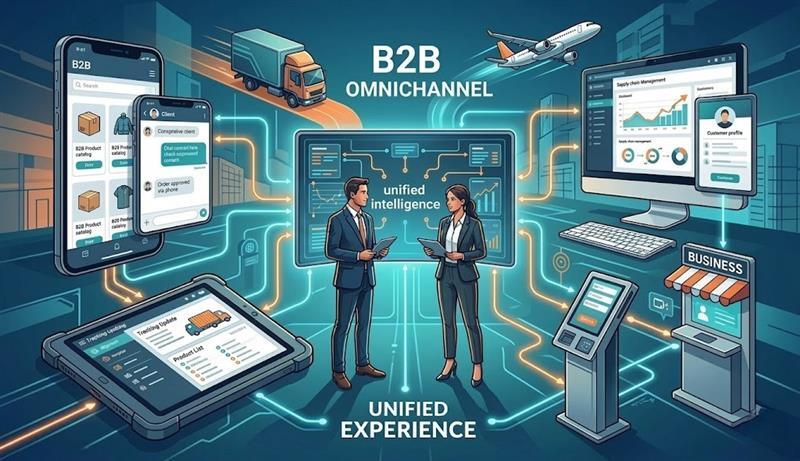
B2B omnichannel engagement means a buyer can reach you through whichever channel suits them — rep, phone, online portal, email, WhatsApp — and get a consistent experience, because every channel writes to the same order record and the same customer data. It is not about adding channels. It is about connecting the ones you already have.
Key facts at a glance
- What it is: multiple channels sharing one source of truth for orders, pricing and stock.
- What it is not: having a website as well as a sales team.
- The test: can a buyer start an order with a rep and finish it online without re-entering anything?
- Most distributors already have the channels. What they lack is the connection between them.
- The failure mode: disconnected channels that give the buyer different answers.
What Is B2B Omnichannel Engagement?
Omnichannel engagement is often explained as “being present on many channels.” That definition is wrong, and it is why so much omnichannel investment disappoints.
A distributor with a sales team, an order desk, a WhatsApp number and a new online portal has four channels. If an order placed by phone is invisible in the portal, if the portal shows a different price from the one the rep quoted, and if the WhatsApp order has to be typed in by hand, that distributor is not omnichannel. They are four separate businesses sharing a logo.
Omnichannel means the channels are interchangeable from the buyer’s point of view. The buyer does not think about which channel they are using. They think about getting the order placed.
Omnichannel vs Multichannel
| Multichannel | Omnichannel | |
|---|---|---|
| Channels | Several | Several |
| Data | Separate per channel | One shared record |
| Pricing | May differ by channel | Identical everywhere |
| Order history | Fragmented | Complete, visible in every channel |
| Buyer switching channels | Starts again | Continues where they left off |
| Rep visibility | Sees only their own orders | Sees everything the account does |
| Typical cause | Channels added over time | Channels deliberately connected |
Almost every distributor is multichannel already. The work is not adding a channel; it is connecting what exists.
The Channels B2B Buyers Actually Use
Ranked by how much volume they carry in a typical distribution business, not by how modern they are.
| Channel | Who uses it | Keep or replace |
|---|---|---|
| Sales rep | Most accounts, especially larger and older ones | Keep — this is your advantage, not your legacy problem |
| Phone / order desk | Urgent orders, less digital buyers | Keep, but stop it being the default |
| Online portal | Buyers ordering outside hours, repeat orders | Build — this is the gap in most distributors |
| Order confirmations, promotions, spreadsheet orders | Keep for comms, retire for order capture | |
| WhatsApp / messaging | Already preferred by many independents | Keep for service, avoid for order capture |
| EDI | Large chain accounts only | Keep where it exists, do not extend it |
| Marketplace | New customer discovery | Optional, and it costs you the customer relationship |
The strategic point: nothing on that list needs removing. Buyers who want to phone should keep phoning. The goal is that a phoned order and a portal order end up in the same place, and that the buyer who phoned can see that order next time they log in.
Why Omnichannel Is Harder in Distribution Than in Retail
Retail omnichannel is largely about inventory visibility and fulfilment options. Distribution adds three problems retail does not have.
Pricing is per-customer. A retailer shows one price everywhere. A distributor has negotiated rates, tier breaks and contract pricing. Every channel must resolve the same price for the same buyer, or the buyer loses trust immediately. This is the single most common point of failure.
The rep is a channel. In retail, staff assist a transaction. In distribution, the rep often is the transaction, and they hold account knowledge in their head rather than in a system. Connecting that channel means changing how reps work, which is a people problem rather than a technical one.
Orders are large and conditional. A hundred-line order with substitutions, backorders and partial delivery is harder to represent consistently across channels than a three-item retail basket.
The One Thing That Makes It Omnichannel: A Single Order Record
If you do only one thing, do this: make every channel write to the same order record in the same system.
What that unlocks, in order of value to the buyer:
- The buyer sees every order, regardless of how it was placed. Phone order this week, portal order next week, both in one history.
- Repeat order works across channels. A buyer can reorder online from an order their rep placed in person.
- Pricing is consistent because it resolves from one place.
- Stock is consistent because every channel reads the same live inventory.
- The rep sees everything. Including the orders the buyer placed online at 11pm, which is exactly the context a rep needs before a visit.
Everything else people describe as omnichannel — unified messaging, consistent branding, cross-channel promotions — is downstream of this. Without one order record, the rest is cosmetic.
How to Sequence It
Most distributors try to do this all at once and stall. A workable order:
| Stage | What you do | Why this order |
|---|---|---|
| 1 | Connect the ERP as the single source of truth for stock, pricing and customers | Everything else reads from here |
| 2 | Launch the portal, writing orders into the ERP | Adds the missing channel and proves the connection |
| 3 | Route phone and rep orders into the same records | Now two channels share one history |
| 4 | Give reps portal access to their accounts | Reps see online activity; portal stops feeling like a threat |
| 5 | Make order status and history visible to the buyer in every channel | The buyer starts experiencing it as one business |
| 6 | Layer messaging and email on top for service and promotion | Communication, not order capture |
Note what is not in stage 1: new channels. The first two stages are plumbing. Distributors who start by adding channels end up with more disconnected channels.
Where the Rep Fits
The fear that an online portal replaces the sales team is the biggest single blocker to omnichannel in distribution, and it is worth addressing directly because it is wrong in a specific way.
Order-taking and selling are different activities. A rep transcribing a list of SKUs is doing data entry. A rep introducing a new line, flagging dead stock or having a category conversation is selling. Omnichannel removes the first and creates time for the second.
What reps gain when channels connect:
- Visibility of what the account orders when the rep is not there
- An accurate picture of declining order frequency, which is the earliest churn signal there is
- The ability to place an order on the spot, in the same system, before interest fades
- Time — often several hours a week returned from admin
Reps who are shown this before launch become the portal’s best advocates. Reps who find out about it afterwards become its biggest obstacle. That sequencing decision matters more than any feature.
Common Omnichannel Mistakes in Distribution
Adding channels before connecting them. The most common and most expensive error. A new portal that does not share data with the order desk makes the experience worse, not better.
Letting prices diverge. Different price in the portal than the rep quoted destroys trust in the portal permanently. Buyers do not give it a second chance.
Treating the portal as a separate business. Separate stock pool, separate targets, separate team. Guarantees internal conflict and double-selling.
Measuring channels against each other. “Portal orders up, phone orders down” is not a result, it is a migration. Measure total account value and order frequency instead.
Launching to everyone at once. Pilot with accounts most likely to adopt, fix what they trip over, then widen.
Ignoring the channel buyers already prefer. If half your accounts message you on WhatsApp, that is data about how they want to be served, not a problem to stamp out.
What to Measure
Omnichannel is usually measured badly, with channel-level vanity metrics. The numbers worth tracking:
- Order frequency per account, across all channels combined. The clearest health signal in distribution.
- Total account value, not portal value. Migration is not growth.
- Share of accounts active in more than one channel. Multi-channel accounts typically order more often and churn less.
- Order entry time per order, which is where the operational saving shows up.
- Order error and credit note rate, which should fall as manual entry falls.
- Rep time spent on order admin, measured before and after.
The trap is celebrating portal adoption while total revenue is flat. That means you moved orders, not that you grew.
Frequently Asked Questions
1. What is B2B omnichannel engagement?
It means a business buyer can use whichever channel suits them — rep, phone, online portal, email or messaging — and get a consistent experience, because every channel writes to the same order record and reads the same pricing, customer and stock data.
2. What is the difference between omnichannel and multichannel?
Multichannel means having several channels that operate separately, each with its own data. Omnichannel means those channels share one source of truth, so a buyer can switch between them without starting over and sees the same prices and order history everywhere.
3. Do distributors need an omnichannel strategy?
Most distributors already operate multiple channels, so the practical question is not whether to have them but whether to connect them. Connecting existing channels usually delivers more than adding new ones.
4. Will an online portal replace our sales reps?
No. It absorbs order-taking, which is data entry rather than selling, and returns rep time for new line introductions, category conversations and account growth. Reps also gain visibility of what accounts order when they are not present.
5. Where should a distributor start with omnichannel?
With the ERP as the single source of truth for stock, pricing and customers. Then launch the portal writing into it, then route phone and rep orders into the same records. Adding channels before connecting them makes the experience worse.
6. What is the most common omnichannel mistake in distribution?
Letting prices differ between channels. If the portal shows a different price from the one a rep quoted, buyers stop trusting the portal and do not return to it. Consistent per-customer pricing across every channel is non-negotiable.
7. How do you measure omnichannel success?
By order frequency and total value per account across all channels combined, the share of accounts active in more than one channel, order entry time, and order error rate. Measuring channels against each other mistakes migration for growth.
8. Is WhatsApp part of a B2B omnichannel strategy?
It can be, for service, availability updates and relationship contact. It is a poor order-capture channel, because a messaged order still has to be typed into a system by someone, which reintroduces the manual entry omnichannel is meant to remove.
9. How long does it take to connect channels?
The ERP connection and portal launch typically take 4 to 8 weeks. Routing rep and phone orders into the same records, and bringing reps fully into the system, usually takes longer because it involves changing how people work rather than configuring software.
Related Reading
- What Is B2B Distribution? — models, channels and margins
- B2B Ecommerce Platform for Distributors — the platform layer underneath this
- B2B Food Marketing Strategies for Distributors — channel tactics for food and beverage accounts
Last updated: 02 October 2026


 Get Started