Introduction: From Marketing Expense to Revenue Engine
Understanding SEO ROI
Why SEO ROI Matters for Business Growth
Ecommerce Platforms and SEO ROI
B2B Ecommerce and Digital Revenue Growth
Marketing Strategies that Improve SEO ROI
POS Systems and Digital Sales Integration
Quick Commerce and the Future of SEO ROI
Measuring SEO ROI Effectively
Challenges in Achieving SEO ROI
Future Trends Influencing SEO ROI
Building a Long-Term SEO ROI Strategy
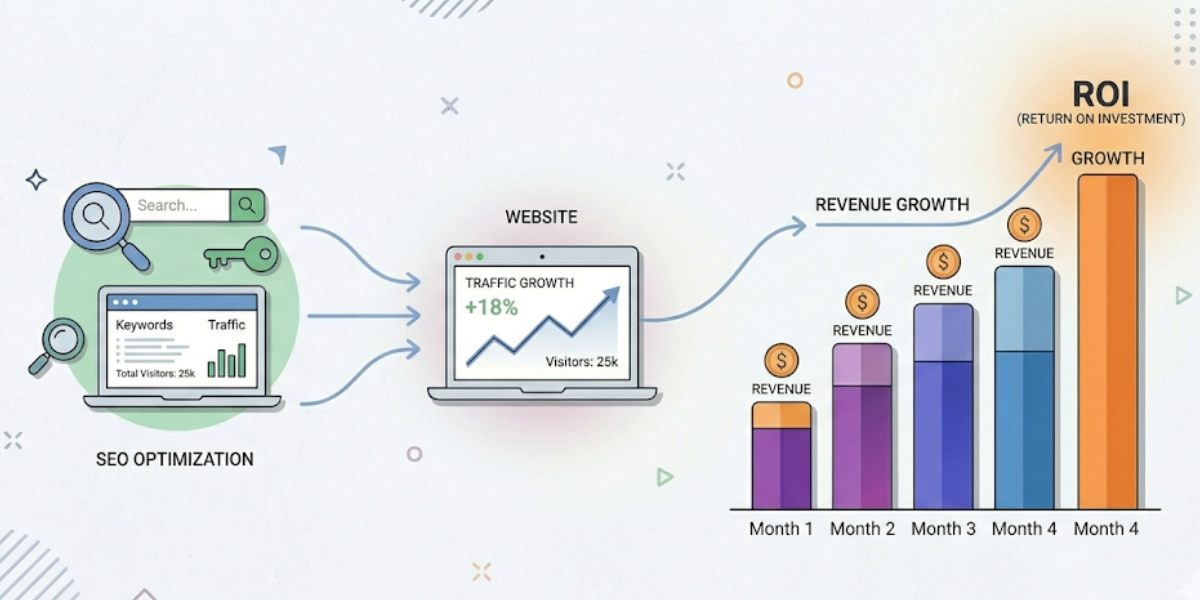
Many companies make significant investments in digital marketing, but they find it difficult to gauge its true financial benefit. Even while traffic, impressions, and clicks may seem impressive, corporations’ main goal is to increase revenue. At this point, SEO ROI emerges as the key indicator of marketing success.
Ranking higher on search engines is just one aspect of search engine optimization. It’s about turning visibility into financial results. When properly implemented, SEO creates steady organic traffic that keeps generating results without requiring continuous advertising expenditures.
Organizations may turn their websites into effective growth engines with a solid SEO ROI strategy. Businesses can create sustainable marketing channels that yield long-term benefits rather than depending only on sponsored campaigns.
By drawing in high-intent clients who are already looking for their goods or services, businesses that concentrate on increasing SEO ROI get a competitive edge.
The return on investment produced by search engine optimization efforts is known as SEO ROI. It calculates the amount of money or business value generated by investing resources in SEO tactics.
Instead of concentrating solely on website traffic, SEO ROI assesses the financial results of SEO, including:
Businesses can ascertain whether their SEO tactics are generating actual business growth by monitoring SEO ROI.
Businesses cannot afford to spend money on marketing without measurable outcomes in a cutthroat digital environment. Organizations can make sure their marketing initiatives are successful by measuring SEO ROI.
The following are some major advantages of concentrating on SEO ROI:
Website traffic, consumer inquiries, and online purchases frequently improve steadily for businesses that consistently optimize their marketing methods for SEO ROI.
Several digital methods must cooperate to achieve a high SEO ROI. Technical optimization, excellent content, and successful e-commerce experiences must all be combined by businesses.
Because search engines favor websites that give consumers useful information, content is crucial to increasing SEO ROI.
Among the successful content strategies are:
Businesses that provide helpful and pertinent information draw in customers who are actively looking for answers. These visitors have a higher chance of becoming clients, which boosts SEO ROI.
Websites with outstanding technological performance are rewarded by search engines. Enhancing technical SEO guarantees that website pages are easily crawled and ranked by search engines.
The following technological advancements boost SEO ROI:
In addition to improving the user experience, these enhancements raise the possibility of improved SEO ROI and higher search ranks.
E-commerce platforms are essential for turning search traffic into income for companies that sell products.
By enabling customers to buy things straight from search results, a well-optimized e-commerce store greatly increases SEO ROI.
Key components of e-commerce SEO include:
These characteristics aid search engines in comprehending the content of websites and presenting goods in pertinent search results.
Additionally, contemporary e-commerce platforms offer sophisticated features including real-time inventory updates, bulk ordering systems, and customer-specific pricing. These features boost SEO ROI and enhance client experience.
To streamline ordering procedures and increase their online presence, a lot of distribution businesses are implementing B2B e-commerce platforms.
By allowing companies to take digital orders straight from search visitors, a robust B2B e-commerce solution may dramatically boost SEO ROI.
Among the main benefits are:
Businesses increase SEO ROI and provide new income opportunities by allowing customers to order things at any time.
When combined with more comprehensive digital marketing tactics, SEO works best. Marketing initiatives can help businesses increase their natural visibility.
Successful marketing campaigns that boost SEO ROI consist of:
Email marketing, SMS alerts, and messaging apps are examples of contemporary communication methods that assist companies in maintaining a relationship with their clientele.
These marketing tactics boost long-term SEO ROI by promoting recurring visitors and purchases.
A successful digital strategy starts with the launch of an e-commerce website. The website is kept competitive and optimized through ongoing maintenance.
SEO ROI is increased by proper maintenance because it guarantees:
Frequent website monitoring also aids in fixing technical problems before they affect the user experience.
Companies that make regular e-commerce maintenance investments safeguard and enhance their SEO ROI over time.
By connecting point-of-sale systems with their online platforms, retail organizations can further improve SEO ROI.
Online and offline sales data are linked in a unified commerce environment created via point-of-sale integration.
Among the main advantages are:
Businesses may improve customer experiences and boost total income from search traffic when point-of-sale (POS) systems integrate smoothly with e-commerce platforms.
The expectations of consumers are changing quickly. Consumers now demand smoother shopping experiences, quicker shipping, and rapid product availability.
Quick commerce solutions increase SEO ROI while assisting companies in meeting these demands.
Crucial fast commerce features include:
These features guarantee that companies may seize sales opportunities as soon as consumers use search engines to find their products.
Improving marketing outcomes requires monitoring the effectiveness of SEO initiatives.
Companies should keep an eye on important variables that have a direct impact on SEO ROI.
Among the crucial performance metrics are:
By using analytics tools, businesses may determine which tactics have the greatest impact on SEO ROI and adjust their marketing strategy accordingly.
Even though SEO has long-term advantages, companies frequently encounter a number of difficulties when attempting to increase their return on investment.
Typical difficulties consist of:
Businesses may greatly increase their SEO ROI by addressing these issues with professional skills and strategic planning.
As technology develops, search engine optimization keeps changing. To sustain a high SEO ROI, businesses must adjust to new trends.
Important developments influencing SEO’s future include:
Businesses who adopt these trends early on will boost their SEO ROI and improve their online presence.
SEO is viewed as a long-term growth strategy rather than a short-term marketing tool by businesses that yield the highest results.
Strong SEO ROI tactics consist of:
Businesses can increase their search exposure and revenue over time by sticking to these tactics.
Impressions and website visits are no longer the only metrics used to determine the success of digital marketing. Companies need to concentrate on quantifiable financial results. For businesses looking for long-term digital success, increasing SEO ROI has become crucial.
Organizations may convert search traffic into actual income by combining effective content strategies, smart e-commerce platforms, integrated marketing efforts, and ongoing website upkeep.
Every enhancement boosts SEO ROI, whether it’s the introduction of cutting-edge B2B e-commerce platforms, the upkeep of high-performing online storefronts, or the integration of digital marketing with business operations.
Now is the ideal time to take action if your company wants to boost digital sales, enhance online exposure, and optimize marketing returns.
Get in touch with our team right now to see how our marketing plans, e-commerce solutions, and knowledge of digital optimization can help your company expand more quickly. Make an appointment for a strategy call or consultation to begin developing a marketing system that produces effective SEO-driven outcomes.
The return on investment (ROI) of search engine optimization is calculated by dividing the cost of adopting SEO methods by the return on investment. It demonstrates how SEO-generated organic traffic, leads, and sales support total business growth and revenue.
SEO ROI is computed by deducting the whole cost of SEO from organic traffic revenue, then dividing the outcome by the SEO cost. The formula to calculate the % return on SEO investment is ROI = (SEO income − SEO cost) ÷ SEO cost × 100.
ROI provides information on how successful a business investment is and how much return it yields in relation to its cost. It assists companies in determining whether their marketing tactics, including SEO initiatives, are yielding quantifiable financial benefits.
Ignoring hidden expenses like labor, tools, and upkeep when calculating returns is a common error in ROI calculations. Another error is concentrating just on immediate outcomes without taking into account long-term advantages like client acquisition, organic traffic increase, and brand visibility.
Depending on the kind of investment and the state of the market, a 3% ROI might be deemed reasonable. Businesses typically strive for a higher ROI in SEO and digital marketing since optimized tactics can produce noticeably higher returns over time.
A 7% ROI indicates that the investment produced a return equivalent to 7% of the initial investment. For instance, if a company invests 100 units and makes 107 units overall, the profit is a 7% return on the initial investment.
Because it enables companies to draw in steady organic traffic from search engines without having to pay for each click, SEO is still profitable. When done well, it can lessen reliance on paid advertising while producing long-term leads, sales, and brand visibility.
On this page Introduction: Why Every Business Needs a Strong SEO Check Strategy Understanding SEO...
On this page Introduction: From Marketing Expense to Revenue Engine Understanding SEO ROI Why SEO...
On this page Introduction: Why SEO Ranking Matters More Than Ever Understanding SEO Ranking Why...
Company
Industry
© 2026 BrainBean. All rights reserved.
 Get Started