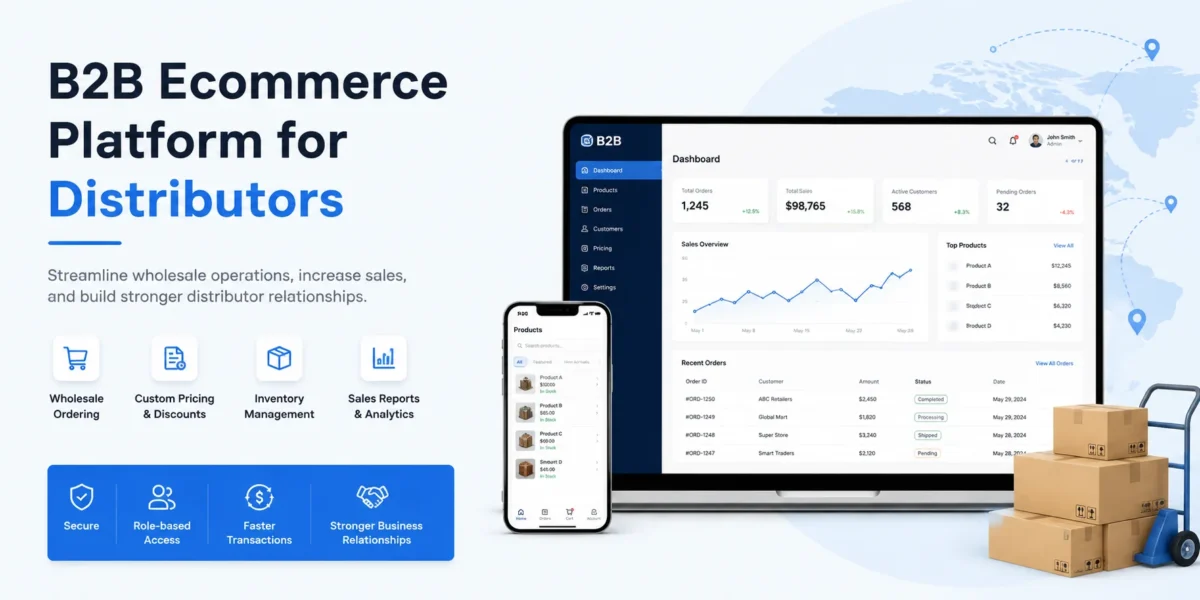
B2B Ecommerce Platform for Distributors
A B2B ecommerce platform for distributors is online store software built for wholesale selling rather than retail. Instead of a single public price and a one-item cart, it handles bulk ordering, customer-specific price lists, credit terms, minimum order quantities and live ERP inventory – so your retailers can place their own orders 24/7 without a sales rep on the phone.
Key facts at a glance
- Who it is for: distributors, wholesalers, importers and suppliers selling to retailers, not consumers.
- What it replaces: phone orders, WhatsApp order lists, emailed PDFs and manual order entry.
- Core difference from B2C: every buyer can see a different catalogue, a different price and a different payment term.
- Typical go-live: 4-8 weeks for a standard catalogue with one ERP connection.
- Biggest single win: order entry time drops to near zero because the buyer does the data entry, not your team.
What Is a B2B Ecommerce Platform for Distributors?
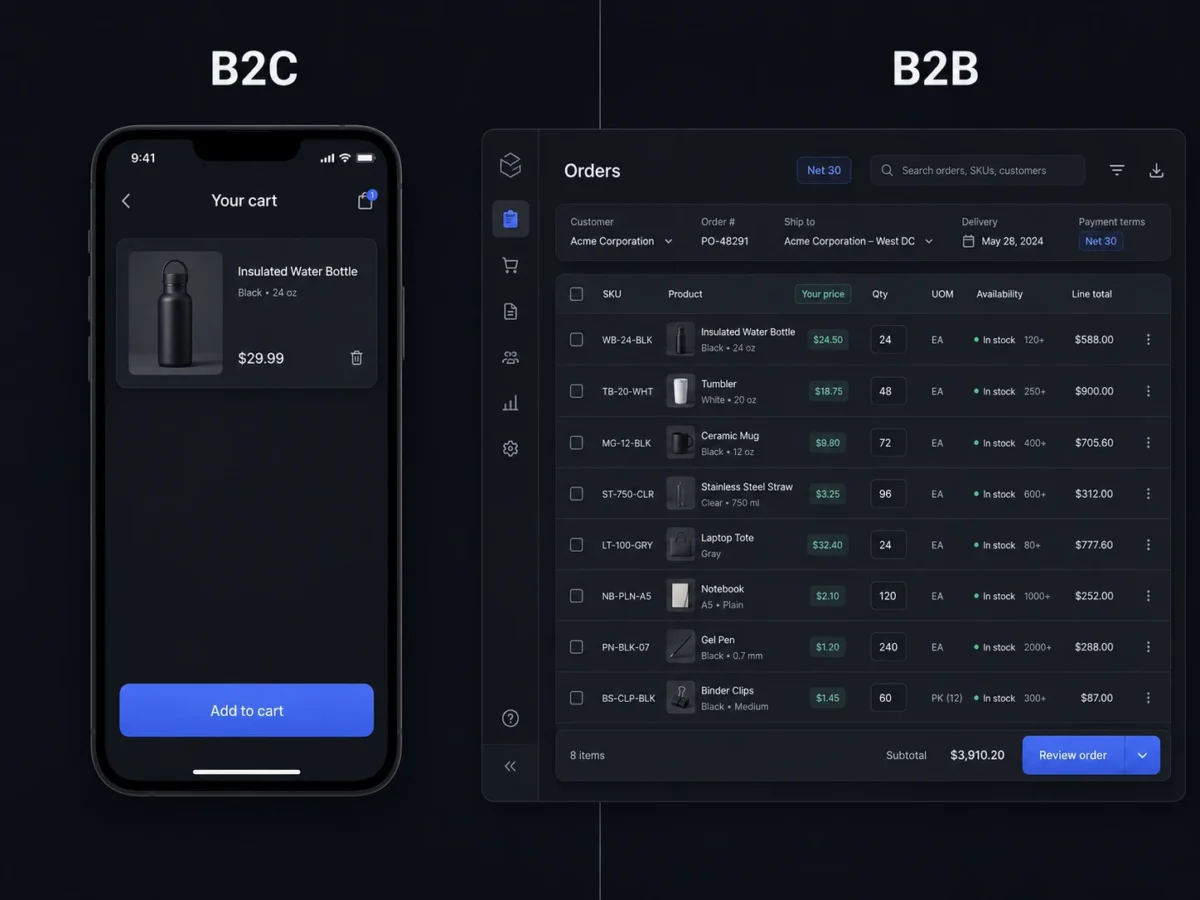
A B2B ecommerce platform for distributors is a private, login-based online store where your approved retail customers browse your catalogue, see the pricing that was agreed with them specifically, and place repeat bulk orders themselves. The order lands directly in your ERP or order management system, already priced, already taxed, and already checked against live stock.
The word “private” is what separates it from a normal ecommerce site. On a B2C store, everyone sees the same product page and the same price. In distribution, a convenience-store chain buying 400 cases a month should not see the same price as a single independent shop buying six. A distributor B2B ecommerce platform is built around that rule from the ground up.
How It Differs From a B2C Online Store
A B2C platform can be forced into wholesale use with plugins, but the seams show fast. The differences that actually break a distributor are these:
- Catalogue visibility. B2B needs per-customer-group product visibility. Exclusive brands, restricted SKUs and territory-locked lines must be hidden from buyers who are not allowed to see them.
- Pricing logic. B2B needs tiered pricing, contract pricing, quantity breaks and negotiated per-account rates running at the same time.
- Order size. A B2C cart is built for three items. A distributor’s cart is built for 300 SKUs entered by SKU code from a spreadsheet.
- Payment. B2C is pay-now. B2B needs net terms, credit limits, part payment, and offline payment against invoice.
- Approval. Larger retail buyers need an internal approval flow before an order is released.
B2B Ecommerce vs Marketplace vs EDI
| B2B Ecommerce Platform | Wholesale Marketplace | EDI | |
|---|---|---|---|
| Who owns the customer | You | The marketplace | You |
| Pricing control | Full, per account | Limited, often public | Full |
| Commission on sales | None | Typically 10-25% | None |
| Setup effort | Moderate | Low | High |
| Works with small retailers | Yes | Yes | Rarely – too technical |
| Branding | Your brand | Marketplace brand | No storefront |
| Best for | Distributors with an existing retailer base | Finding new buyers | Large chain accounts |
Most established distributors need the first column. You already have the customers – what you are missing is a way for them to order without occupying your sales team.
Why Distributors Are Moving Their Order Book Online
The pressure is coming from both sides of the business.
On the cost side: manual order entry is the single most expensive non-value-adding task in a distribution business. Every phoned-in order gets typed twice – once by the buyer into their own list, once by your team into the ERP. Every typo becomes a credit note, a return, or a lost customer.
On the revenue side: retail buyers now expect to order at 11pm on a Sunday because that is when they finish counting stock. If your order desk closes at 6pm, that order goes to whichever distributor’s site is open. Availability is now a competitive feature.
On the margin side: an online store makes upsell and cross-sell automatic. A rep can remember to push one add-on. A platform suggests the right add-on on every single line item, on every single order, forever.
On the working-capital side: live inventory means you stop selling what you do not have. Backorder and pre-order capture the sale instead of losing it.
12 Features Every Distributor B2B Ecommerce Platform Needs
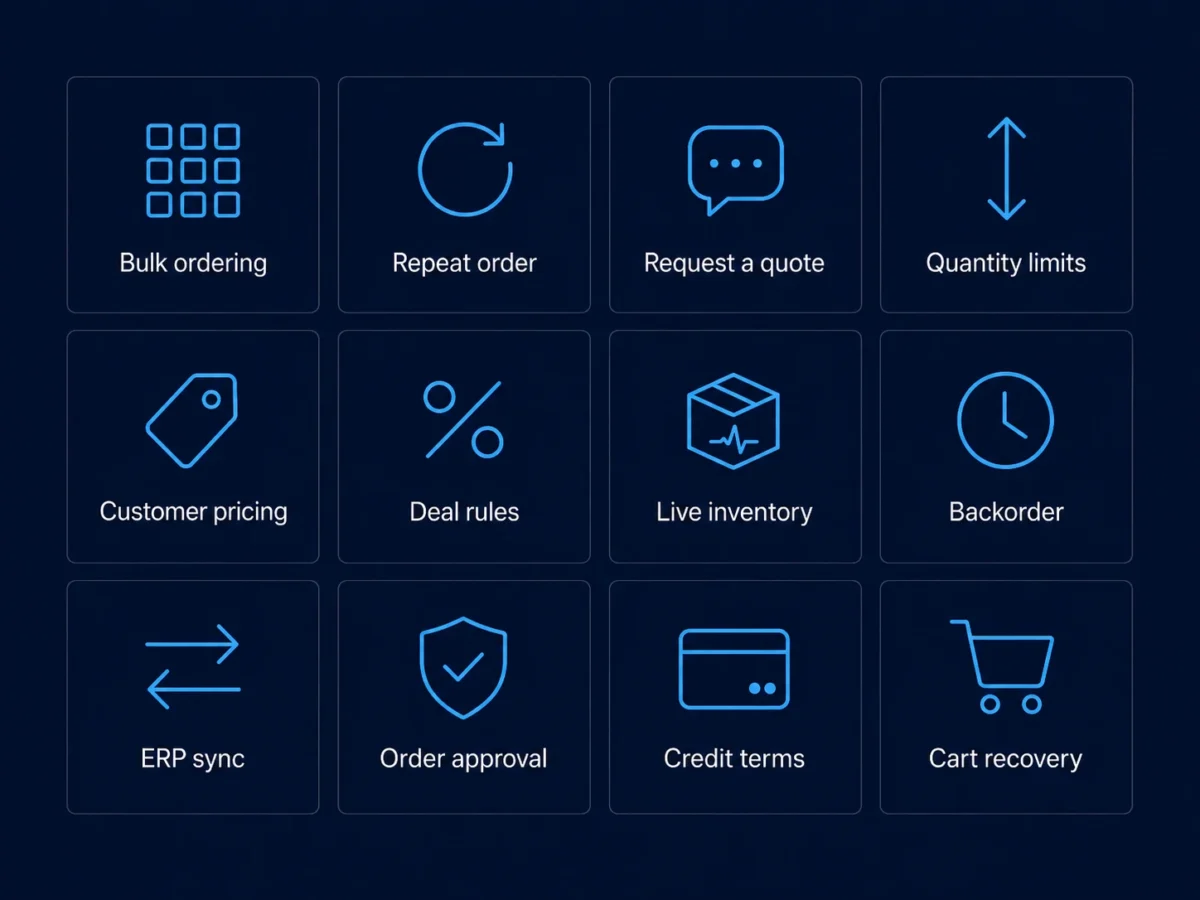
If a vendor cannot demonstrate all twelve of these in a live demo, the platform is a retail product wearing a wholesale label.
| # | Feature | Why a distributor needs it |
|---|---|---|
| 1 | Bulk / quick order by SKU | Buyers paste 200 SKU codes and quantities in one screen |
| 2 | Repeat order | One click to reorder last month’s list – drives order frequency |
| 3 | Request a quote | For negotiated lines that should not carry a public price |
| 4 | Min & max quantity limits | Enforces case packs, MOQs and allocation on scarce stock |
| 5 | Customer-specific pricing | Each account sees only its own agreed rate |
| 6 | Group pricing & deal rules | Tiered breaks, BOGO and seasonal offers without manual edits |
| 7 | Real-time inventory sync | Prevents overselling and the credit notes that follow |
| 8 | Backorder & pre-order | Captures the sale during a stockout instead of losing it |
| 9 | ERP integration | Orders, stock, customers and invoices move without re-keying |
| 10 | Order approval workflow | Multi-user retail buyers need internal sign-off |
| 11 | Flexible payments & credit | Online, offline and on-account payment, with credit rules |
| 12 | Abandoned cart recovery | Wholesale carts are large – recovering even a few is material |
Ordering
Wholesale ordering is data entry, not browsing. A buyer who already knows what they want should be able to reach checkout in under two minutes. That means a quick-order grid, a searchable SKU field, saved order templates, and a
one-click repeat of any previous order. Quote requests handle the lines where price is negotiated case by case.
Pricing and Inventory
This is where retail platforms fail hardest. Your platform must hold multiple price books at once and resolve them in a predictable order: contract price beats group price, group price beats tier price, tier price beats list price. Inventory must read from the ERP in real time, and when a line runs dry the system should offer a backorder rather than a dead end.
Integration and Retention
An online store that does not talk to your ERP just moves the typing from your buyer to your admin team. Order sync, customer sync and stock sync must run automatically. On top of that, retention tooling – push alerts, back-in-stock notifications, product recommendations and abandoned cart recovery – is what turns a store from an order form into a growth channel.
How a B2B Ecommerce Platform Works for a Distribution Business
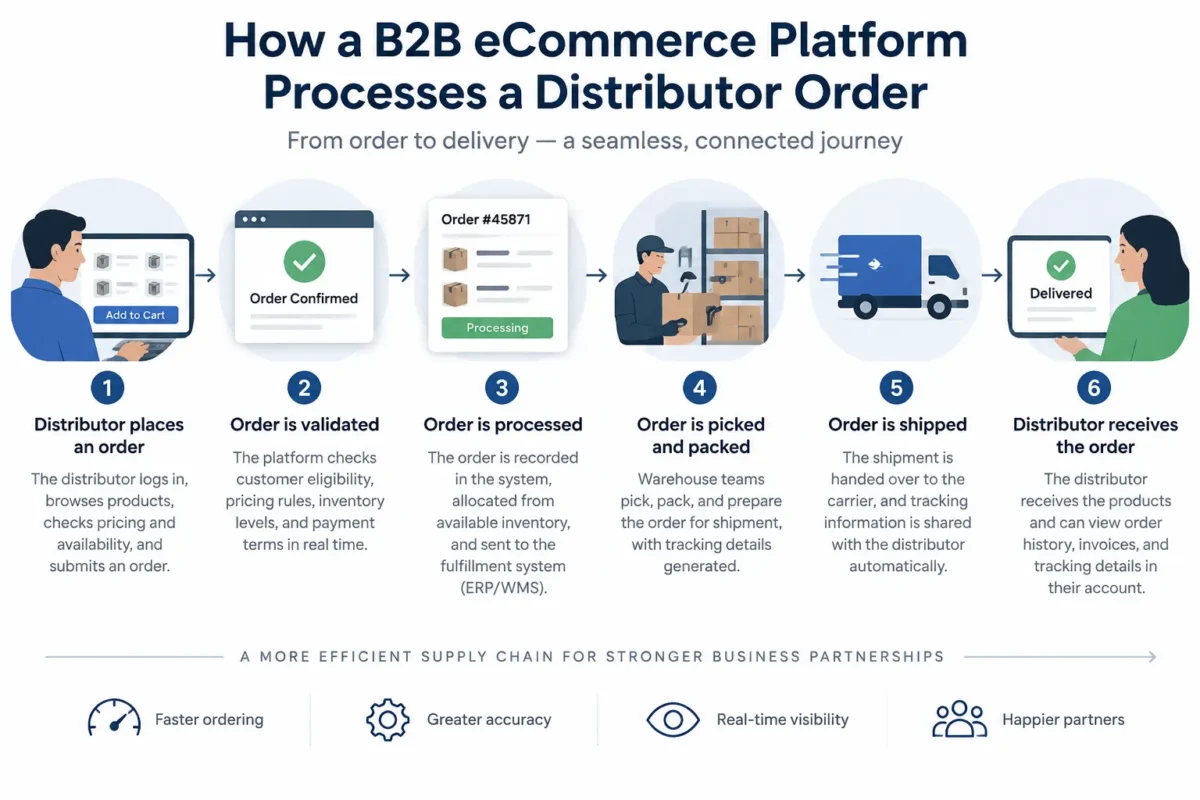
- Customer onboarding. Retailers register through a custom B2B registration form, or you bulk import your existing account list. Each account is assigned to a customer group.
- Catalogue and pricing setup. Products, brands and categories are published, then visibility and price rules are attached to each group.
- ERP connection. Stock levels, customer records and order data are mapped between the store and your ERP.
- Buyer logs in. They see only their catalogue, at their prices, with live stock.
- Order placed. Bulk grid, repeat order or standard browse – whichever suits that buyer.
- Order lands in the ERP. Priced, taxed and stock-checked, with no manual entry.
- Fulfilment and updates. Shipping and invoice status flow back to the buyer’s account.
ERP Integration: The Part Most Distributors Get Wrong
The most common failure in distributor ecommerce projects is treating ERP integration as a phase two item. It is not. A store without ERP sync creates a second version of the truth, and within a month your team is reconciling stock by hand.
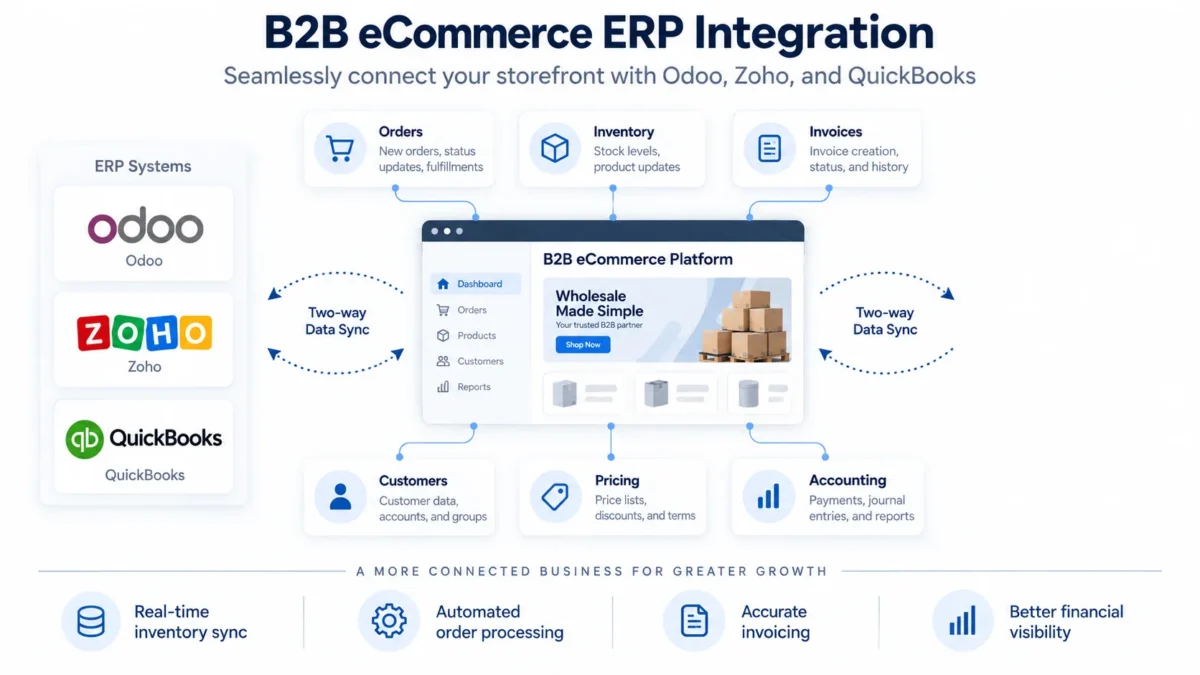
Three questions to settle before you sign anything:
- What syncs, and in which direction? Inventory and pricing usually flow ERP-to-store. Orders and new customers flow store-to-ERP. Get this on paper.
- How often? Real-time for inventory. Near-real-time for orders. Anything slower than that on stock and you will oversell.
- What happens when the sync fails? There must be a retry queue and an alert, not silence.
Brainbean B2B connects with Odoo, Zoho, QuickBooks, Inflow and custom ERP stacks, plus shipping (UPS, FedEx, Shiprocket), payments (Stripe, PayPal, Authorize.net, Razorpay, PayU) and marketing tools (Klaviyo, Mailchimp, Brevo).
Distribution Industries We Build For
Different distribution categories need different rules. Case packs matter in beverage. Trend speed matters in novelty. Compliance matters in counter culture. These pages go deeper on each:
- Counter Culture Distribution
- General Merchandise Distribution
- Novelty Product Distribution
- Beverage Distribution
- Fashion Accessories Distribution
- Candy & Confectionery Distribution
How to Choose a B2B Ecommerce Platform (9-Point Checklist)
- Can it hold at least three pricing layers at once, per account?
- Can it hide products and prices from specific customer groups?
- Does it sync inventory with your ERP in real time – in a live demo, not a slide?
- Can a buyer place a 200-line order in under three minutes?
- Does it support credit terms and offline payment against invoice?
- Can you import your existing customer list without retyping it?
- Does it work properly on a phone, in a stockroom, on bad wifi?
- Who fixes it when it breaks, and how fast do they answer?
- What is the total cost including integration, not just the licence?
Insist on running your own catalogue and your own price rules during the demo. A demo on the vendor’s clean sample data proves nothing about your SKU count, your pack sizes or your pricing complexity.
What Does a Distributor B2B Ecommerce Platform Cost?
Cost varies with four things, in roughly this order of impact:
- ERP integration complexity. A standard connector to a mainstream ERP is straightforward. A twenty-year-old custom system is not.
- Catalogue size and data quality. Cleaning 12,000 SKUs with inconsistent images and missing attributes is often the largest line item.
- Pricing rule complexity. Ten customer groups is simple. Four hundred individually negotiated accounts takes longer.
- Ongoing support model. Maintenance, updates and someone who answers the phone when payments fail.
The number worth measuring against is not licence cost – it is hours of manual order entry removed per week, multiplied by your loaded cost per hour, plus the value of orders placed outside business hours.
Common Mistakes Distributors Make When Going Online
- Launching with dirty product data. Inconsistent image sizes and missing descriptions make a wholesale catalogue unusable. Fix data first.
- Copying the B2C playbook. Your buyers are not browsing. Optimise for speed of reordering, not for discovery.
- Leaving the sales team out. Reps fear the store replaces them. It does not – it removes their admin so they can sell. Bring them in early.
- No launch push. Retailers will not find the portal by themselves. Email, WhatsApp, printed inserts in deliveries, and reps walking buyers through their first order.
- Treating go-live as the finish line. The first ninety days of adoption work is what determines whether the platform pays for itself.
Frequently Asked Questions
What is a B2B ecommerce platform for distributors?
It is login-based online store software built for wholesale selling. It handles bulk ordering, customer-specific pricing, minimum order quantities, credit terms and live ERP inventory, so approved retailers can order 24/7 without contacting a sales rep.
How is B2B ecommerce different from B2C ecommerce?
In B2C, every visitor sees the same catalogue and the same price. In B2B, each account can see a different catalogue, a different price and different payment terms, and orders are typically large multi-line bulk orders rather than single items.
Do I need a separate B2B store if I already sell direct to consumers?
Usually yes, or at minimum a separate customer-group layer. Wholesale pricing must never be publicly visible, and wholesale ordering behavior is different enough that mixing both experiences on one storefront hurts both.
Can a B2B ecommerce platform integrate with my ERP?
Yes. Brainbean B2B integrates with Odoo, Zoho, QuickBooks, Inflow and custom systems, syncing inventory, orders and customer data automatically in both directions.
How long does it take to launch a B2B ecommerce store?
A standard catalogue with one ERP connection typically goes live in 4-8 weeks. Product data cleanup and complex pricing rules are the two factors that extend that timeline most.
Can each customer see their own pricing?
Yes. Customer-specific and group-specific pricing lets you apply negotiated rates, tier breaks and contract prices per account, so no buyer ever sees another buyer’s price.
What happens when a product goes out of stock?
Real-time inventory sync marks it unavailable, and backorder or pre-order capture lets the buyer still place the order. Back-in-stock notifications tell them automatically when it returns.
Will my sales reps become redundant?
No. The platform absorbs order entry, which is the lowest-value part of a rep’s day. Reps shift to account growth, new-line introductions and margin work.
Can retailers pay on credit terms?
Yes. Conditional payment options support online payment, offline payment against invoice, and on-account purchasing within a defined credit limit.
How do I get my existing customers to actually use the portal?
Bulk import their accounts so there is no signup friction, have reps place the first order alongside each buyer, and give a small incentive on the first three online orders. Adoption is a rollout problem, not a software problem.
What does a B2B ecommerce platform for distributors cost?
Cost depends mainly on ERP integration complexity, catalogue size and data quality, and pricing rule complexity. Measure it against manual order-entry hours removed and orders captured outside business hours.
Can I control which products certain customers see?
Yes. Smart visibility controls restrict products, brands and entire categories to specific customer groups, which is essential for exclusive lines and territory-restricted stock.
Take Your Distribution Business Online
If your team is still typing orders that your customers already typed once, that is the number to fix first. Book a demo and we will run it on your catalogue and your pricing rules – not on sample data.
Last updated: 08 September 2026
 Get Started